Day-of-week effects for count data
Code
import jax.numpy as jnp
import numpy as np
import numpyro
import pandas as pd

from pyrenew.observation import (
    PopulationCounts,
    NegativeBinomialNoise,
    PoissonNoise,
)
from pyrenew.deterministic import DeterministicVariable, DeterministicPMF
from pyrenew import datasets

import plotnine as p9
from plotnine.exceptions import PlotnineWarning
import warnings

warnings.filterwarnings("ignore", category=PlotnineWarning)

from _tutorial_theme import theme_tutorial
Many health surveillance signals exhibit strong day-of-week patterns. Emergency department visits and hospital admissions tend to be higher on weekdays and lower on weekends, driven by staffing, patient behavior, and reporting practices. Ignoring this weekly periodicity forces the noise model to absorb systematic variation, inflating dispersion estimates and obscuring the underlying epidemic trend.
PyRenew models day-of-week effects as a multiplicative adjustment applied to predicted counts after the delay convolution and ascertainment scaling:
where \(d_{w(t)}\) is the day-of-week multiplier for the weekday of timepoint \(t\), \(\alpha\) is the ascertainment rate, and \(\pi(s)\) is the delay PMF. The effect vector \(\mathbf{d} = (d_0, d_1, \ldots, d_6)\) has one entry per day (0=Monday through 6=Sunday, ISO convention). An effect of 1.0 means no adjustment for that day. When the effects sum to 7.0, the average daily multiplier is 1.0, preserving weekly totals and keeping the ascertainment rate directly interpretable as the fraction of infections observed.
Defining a day-of-week effect
A typical pattern for ED visits might show weekday effects above 1.0 and weekend effects below 1.0:
Code
dow_values = jnp.array([1.20, 1.15, 1.10, 1.05, 1.00, 0.75, 0.75])
day_names = ["Mon", "Tue", "Wed", "Thu", "Fri", "Sat", "Sun"]

print(f"Day-of-week effects: {np.round(np.array(dow_values), 2)}")
print(f"Sum: {float(jnp.sum(dow_values)):.2f}")
Day-of-week effects: [1.2  1.15 1.1  1.05 1.   0.75 0.75]
Sum: 7.00
Code
dow_df = pd.DataFrame({"day": day_names, "effect": np.array(dow_values)})
dow_df["day"] = pd.Categorical(dow_df["day"], categories=day_names, ordered=True)

(
    p9.ggplot(dow_df, p9.aes(x="day", y="effect"))
    + p9.geom_col(fill="steelblue", alpha=0.7, color="black")
    + p9.geom_hline(yintercept=1.0, linetype="dashed", color="grey")
    + p9.labs(
        x="Day of Week",
        y="Multiplicative Effect",
        title="Day-of-Week Effect Vector",
    )
    + theme_tutorial
)
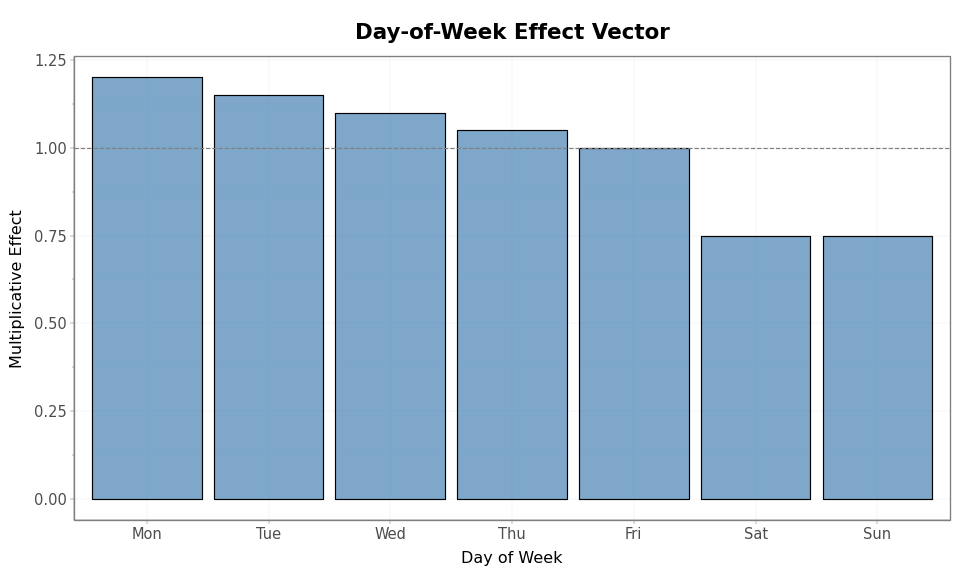
Values above the dashed line (1.0) increase predicted counts for that day; values below decrease them. Monday at 1.20 means 20% more counts than an average day; Saturday and Sunday at 0.75 mean 25% fewer.
Observation process with and without day-of-week effects
We construct two PopulationCounts observation processes using the same
delay distribution and ascertainment rate. The only difference is
whether day_of_week_rv is provided.
Code
hosp_delay_pmf = jnp.array(
    datasets.load_example_infection_admission_interval()["probability_mass"].to_numpy()
)
delay_rv = DeterministicPMF("inf_to_hosp_delay", hosp_delay_pmf)
ihr_rv = DeterministicVariable("ihr", 0.01)
concentration_rv = DeterministicVariable("concentration", 20.0)

process_no_dow = PopulationCounts(
    name="hosp_no_dow",
    ascertainment_rate_rv=ihr_rv,
    delay_distribution_rv=delay_rv,
    noise=NegativeBinomialNoise(concentration_rv),
)

process_with_dow = PopulationCounts(
    name="hosp_dow",
    ascertainment_rate_rv=ihr_rv,
    delay_distribution_rv=delay_rv,
    noise=NegativeBinomialNoise(concentration_rv),
    day_of_week_rv=DeterministicVariable("dow_effect", dow_values),
)
We simulate a growing epidemic and generate predicted counts from both
processes. The first_day_dow parameter tells PyRenew which day of the
week corresponds to element 0 of the time axis. Here we set
first_day_dow=0 (Monday).
Code
day_one = process_no_dow.lookback_days()
n_total = 130
infections = 5000.0 * jnp.exp(0.03 * jnp.arange(n_total))

with numpyro.handlers.seed(rng_seed=0):
    result_no_dow = process_no_dow.sample(infections=infections, obs=None)
with numpyro.handlers.seed(rng_seed=0):
    result_with_dow = process_with_dow.sample(
        infections=infections, obs=None, first_day_dow=0
    )
Code
n_plot_days = n_total - day_one
pred_rows = []
for i in range(n_plot_days):
    day_idx = day_one + i
    pred_rows.append(
        {
            "day": i,
            "admissions": float(result_no_dow.predicted[day_idx]),
            "type": "No day-of-week effect",
        }
    )
    pred_rows.append(
        {
            "day": i,
            "admissions": float(result_with_dow.predicted[day_idx]),
            "type": "With day-of-week effect",
        }
    )
pred_df = pd.DataFrame(pred_rows)
pred_df["type"] = pd.Categorical(
    pred_df["type"],
    categories=["No day-of-week effect", "With day-of-week effect"],
    ordered=True,
)

(
    p9.ggplot(pred_df, p9.aes(x="day", y="admissions", color="type", linetype="type"))
    + p9.geom_line(size=1)
    + p9.scale_color_manual(values=["steelblue", "#e41a1c"])
    + p9.scale_linetype_manual(values=["solid", "dashed"])
    + p9.labs(
        x="Day",
        y="Predicted Admissions",
        title="Predicted Admissions:\nWith vs. Without Day-of-Week Effect",
        color="",
        linetype="",
    )
    + theme_tutorial
)
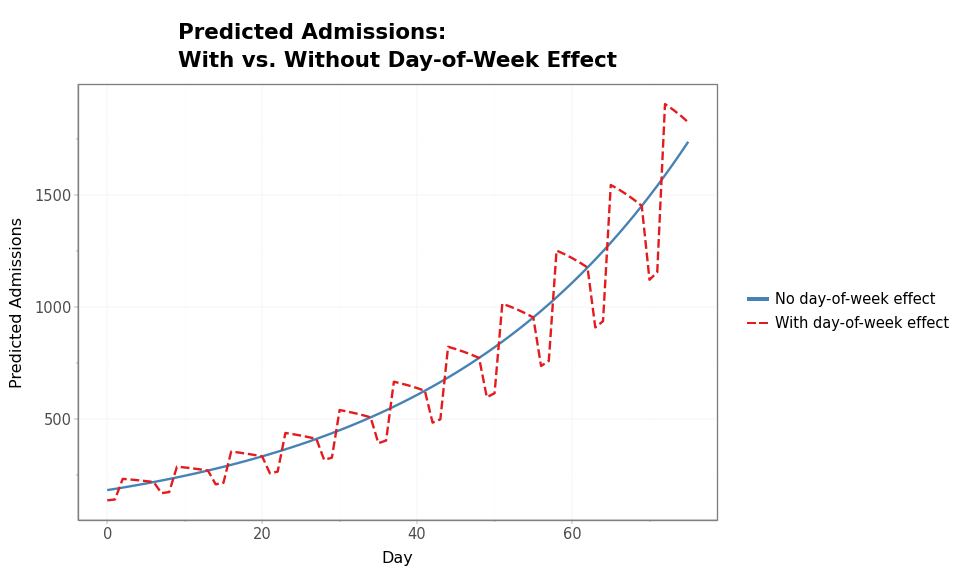
Without the day-of-week effect the predicted curve is smooth. With it, the curve oscillates with a 7-day period — dipping on weekends and rising on weekdays — while following the same overall trend.
Effect of the offset
The first_day_dow parameter aligns the weekly pattern to the calendar.
Changing it shifts which days receive which multiplier. Here we compare
starting on Monday vs. Wednesday:
Code
with numpyro.handlers.seed(rng_seed=0):
    result_monday = process_with_dow.sample(
        infections=infections, obs=None, first_day_dow=0
    )
with numpyro.handlers.seed(rng_seed=0):
    result_wednesday = process_with_dow.sample(
        infections=infections, obs=None, first_day_dow=2
    )
Code
offset_rows = []
for i in range(21):
    day_idx = day_one + i
    offset_rows.append(
        {
            "day": i,
            "admissions": float(result_monday.predicted[day_idx]),
            "offset": "first_day_dow=0 (Monday)",
        }
    )
    offset_rows.append(
        {
            "day": i,
            "admissions": float(result_wednesday.predicted[day_idx]),
            "offset": "first_day_dow=2 (Wednesday)",
        }
    )
offset_df = pd.DataFrame(offset_rows)
offset_df["offset"] = pd.Categorical(
    offset_df["offset"],
    categories=[
        "first_day_dow=0 (Monday)",
        "first_day_dow=2 (Wednesday)",
    ],
    ordered=True,
)

(
    p9.ggplot(
        offset_df,
        p9.aes(x="day", y="admissions", color="offset"),
    )
    + p9.geom_line(size=1)
    + p9.geom_point(size=2)
    + p9.scale_color_manual(values=["steelblue", "#e41a1c"])
    + p9.labs(
        x="Day",
        y="Predicted Admissions",
        title="Effect of first_day_dow on Weekly Pattern Alignment",
        color="",
    )
    + theme_tutorial
)
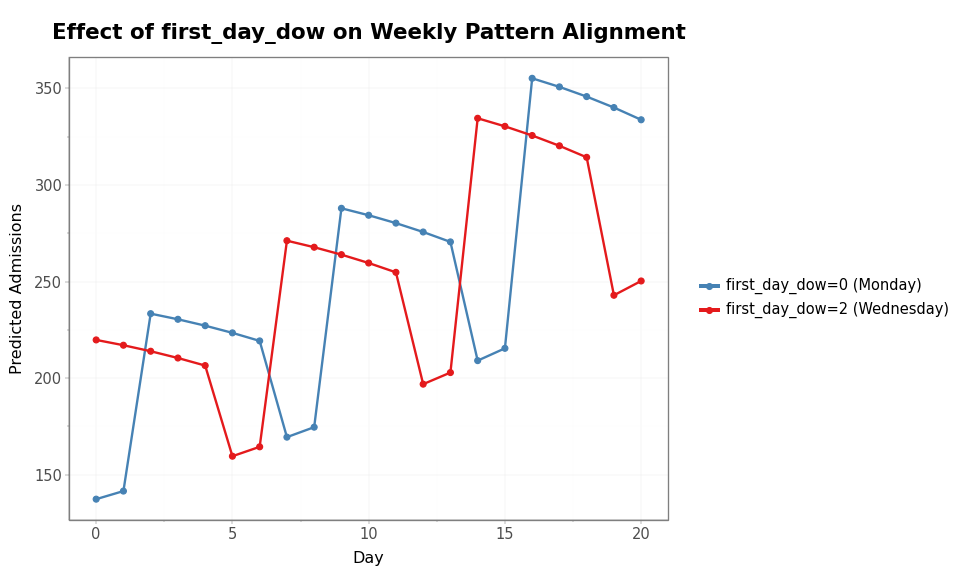
The two curves have the same shape but are phase-shifted: their weekend
dips fall on different days. Getting first_day_dow right matters — a
misaligned offset would attribute Monday’s high to Sunday or vice versa.
When using MultiSignalModel, pass obs_start_date (the date of the
first observation day) to model.sample() or model.run(). The model
handles the calendar bookkeeping and forwards the day-of-week
information to every component that needs it.
Sampled observations
Day-of-week effects shape the noise draws, not just the predicted means. The noise model samples from a distribution centered on the adjusted predictions, so sampled observations inherit the weekly pattern.
Code
n_samples = 30
noisy_results = []
for seed in range(n_samples):
    with numpyro.handlers.seed(rng_seed=seed):
        result_no = process_no_dow.sample(infections=infections, obs=None)
    with numpyro.handlers.seed(rng_seed=seed):
        result_yes = process_with_dow.sample(
            infections=infections, obs=None, first_day_dow=0
        )
    for i in range(n_plot_days):
        day_idx = day_one + i
        noisy_results.append(
            {
                "day": i,
                "admissions": float(result_no.observed[day_idx]),
                "type": "No day-of-week effect",
                "sample": seed,
            }
        )
        noisy_results.append(
            {
                "day": i,
                "admissions": float(result_yes.observed[day_idx]),
                "type": "With day-of-week effect",
                "sample": seed,
            }
        )
Code
noisy_df = pd.DataFrame(noisy_results)
mean_df = noisy_df.groupby(["day", "type"])["admissions"].mean().reset_index()

(
    p9.ggplot(noisy_df, p9.aes(x="day", y="admissions"))
    + p9.geom_line(p9.aes(group="sample"), alpha=0.15, size=0.4, color="steelblue")
    + p9.geom_line(
        data=mean_df,
        mapping=p9.aes(x="day", y="admissions"),
        color="#e41a1c",
        size=1.2,
    )
    + p9.facet_wrap("~ type", ncol=1)
    + p9.labs(
        x="Day",
        y="Hospital Admissions",
        title="Sampled Observations:\nWith vs. Without Day-of-Week Effect",
    )
    + theme_tutorial
)
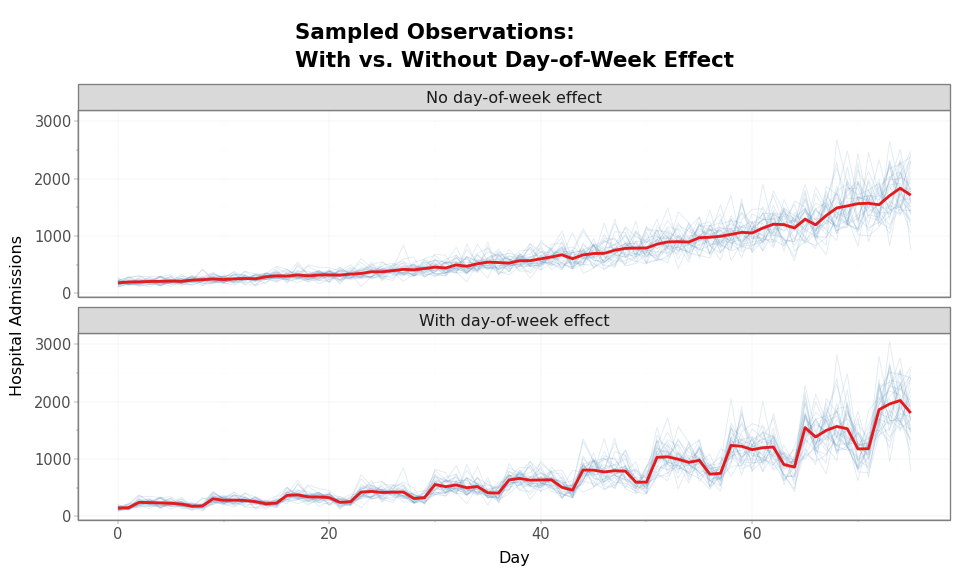
The top panel shows smooth variation around the trend. The bottom panel shows systematic weekly oscillation in both the mean (red) and individual samples (blue) — the weekend dips are visible even through the noise.
Composing with right-truncation
Day-of-week effects and right-truncation are independent adjustments that compose naturally. Day-of-week is applied first (adjusting the expected counts for reporting patterns), then right-truncation scales down recent counts for incomplete reporting:
Code
reporting_delay_pmf = jnp.array([0.4, 0.3, 0.15, 0.08, 0.04, 0.02, 0.01])

process_both = PopulationCounts(
    name="hosp_both",
    ascertainment_rate_rv=ihr_rv,
    delay_distribution_rv=delay_rv,
    noise=NegativeBinomialNoise(concentration_rv),
    day_of_week_rv=DeterministicVariable("dow_effect", dow_values),
    right_truncation_rv=DeterministicPMF("reporting_delay", reporting_delay_pmf),
)

with numpyro.handlers.seed(rng_seed=0):
    result_both = process_both.sample(
        infections=infections,
        obs=None,
        first_day_dow=0,
        right_truncation_offset=0,
    )
Code
compose_rows = []
for i in range(n_plot_days):
    day_idx = day_one + i
    compose_rows.append(
        {
            "day": i,
            "admissions": float(result_with_dow.predicted[day_idx]),
            "type": "Day-of-week only",
        }
    )
    compose_rows.append(
        {
            "day": i,
            "admissions": float(result_both.predicted[day_idx]),
            "type": "Day-of-week + right-truncation",
        }
    )
compose_df = pd.DataFrame(compose_rows)
compose_df["type"] = pd.Categorical(
    compose_df["type"],
    categories=["Day-of-week only", "Day-of-week + right-truncation"],
    ordered=True,
)

(
    p9.ggplot(
        compose_df,
        p9.aes(x="day", y="admissions", color="type", linetype="type"),
    )
    + p9.geom_line(size=1)
    + p9.scale_color_manual(values=["steelblue", "#e41a1c"])
    + p9.scale_linetype_manual(values=["solid", "dashed"])
    + p9.labs(
        x="Day",
        y="Predicted Admissions",
        title="Day-of-Week Effect Composed with Right-Truncation",
        color="",
        linetype="",
    )
    + theme_tutorial
)
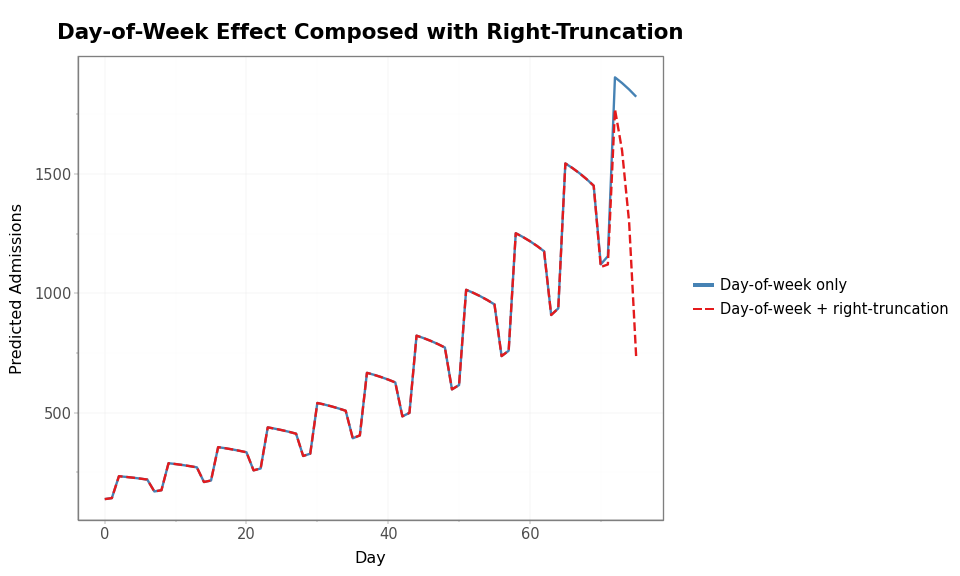
The two curves agree in the early period. Near the right edge, right-truncation pulls the curve downward on top of the weekly oscillation. Each adjustment operates on its own concern — weekly reporting patterns vs. incomplete recent data — and they combine multiplicatively without interfering.
Summary
Day-of-week adjustment is enabled by passing a day_of_week_rv at
construction time and a first_day_dow at sample time.
| Parameter | Where | Purpose |
|---|---|---|
day_of_week_rv |
Constructor | 7-element multiplicative effect vector (0=Mon, 6=Sun) |
first_day_dow |
sample() |
Day of the week for element 0 of the time axis |
When either is None, the adjustment is disabled and the process
behaves identically to one without day-of-week effects.
The effect vector can be supplied as a fixed DeterministicVariable
from empirical data, or as a stochastic RandomVariable (e.g., a scaled
Dirichlet prior) to infer the weekly pattern from data. Effects summing
to 7.0 preserve weekly totals and keep the ascertainment rate
interpretable; other sums rescale overall predicted counts.