PyRenew’s RandomVariable abstract base class
Design principle: all quantities are RandomVariables
In a Bayesian model, all quantities — data, parameters, hyperparameters, derived computations — are random variables living in a single joint probability model (Gelman et al., BDA3 §1.3). The only distinction is whether a given quantity is known (observed, conditioned on) or unknown (to be inferred). A fixed constant is just a degenerate random variable; an estimated rate is a draw from a prior. Both participate in the same joint distribution.
PyRenew embodies this through its RandomVariable abstract base class.
All model components implement the same sample() interface, so you can
swap a fixed quantity for an estimated one — or vice versa — without
changing any surrounding model code.
import jax.numpy as jnp
import numpy as np
import numpyro
import numpyro.distributions as dist
import pandas as pd
import plotnine as p9
import warnings

from plotnine.exceptions import PlotnineWarning
from _tutorial_theme import theme_tutorial

from pyrenew.metaclass import RandomVariable
from pyrenew.deterministic import DeterministicVariable, DeterministicPMF
from pyrenew.randomvariable import (
    DistributionalVariable,
    StaticDistributionalVariable,
    DynamicDistributionalVariable,
    LogitNormalVariable,
    TransformedVariable,
)
from pyrenew.observation import PopulationCounts, NegativeBinomialNoise
import pyrenew.transformation as transformation
from pyrenew import datasets

warnings.filterwarnings("ignore", category=PlotnineWarning)
Concrete implementations
PyRenew provides four RandomVariable implementations that cover most
modeling needs.
DeterministicVariable
A degenerate random variable that returns a fixed value. Its sample()
method simply returns the stored value, unchanged.
ihr_fixed = DeterministicVariable("ihr", 0.01)

with numpyro.handlers.seed(rng_seed=0):
    value = ihr_fixed()
    print(f"IHR (fixed): {value}")
IHR (fixed): 0.01
DeterministicPMF specializes this for probability mass functions,
validating at construction time that the values sum to 1:
delay_pmf = DeterministicPMF(
    "delay",
    jnp.array([0.0, 0.1, 0.3, 0.3, 0.2, 0.1]),
)

with numpyro.handlers.seed(rng_seed=0):
    pmf = delay_pmf()
    print(f"Delay PMF: {np.round(np.array(pmf), 2)}, sum: {pmf.sum():.1f}")
Delay PMF: [0. 0.1 0.3 0.3 0.2 0.1], sum: 1.0
DistributionalVariable
A random variable that draws from a numpyro distribution via
numpyro.sample(). The DistributionalVariable factory function
dispatches to one of two classes depending on whether the distribution
is known at construction time or built at sample time.
StaticDistributionalVariable: the distribution is fully specified at construction time.
# IHR with a Beta(2, 198) prior: mean ~1%, moderate uncertainty
ihr_estimated = DistributionalVariable("ihr", dist.Beta(2, 198))
print(f"Type: {type(ihr_estimated).__name__}")

with numpyro.handlers.seed(rng_seed=0):
    print(f"IHR (sampled): {ihr_estimated():.4f}")
Type: StaticDistributionalVariable
IHR (sampled): 0.0221
DynamicDistributionalVariable: the distribution is constructed at sample time from a callable. This is useful when distribution parameters depend on other sampled quantities.
# A Normal whose location is determined at sample time
dynamic_rv = DistributionalVariable(
    "dynamic_normal",
    lambda loc: dist.Normal(loc, 0.1),
)
print(f"Type: {type(dynamic_rv).__name__}")

with numpyro.handlers.seed(rng_seed=0):
    print(f"Sample (loc=2.0): {dynamic_rv.sample(2.0):.3f}")
    print(f"Sample (loc=5.0): {dynamic_rv.sample(5.0):.3f}")
Type: DynamicDistributionalVariable
Sample (loc=2.0): 1.756
Sample (loc=5.0): 4.874
TransformedVariable
Wraps another RandomVariable and applies a deterministic
transformation to its output. This is useful for reparameterizations and
derived quantities.
# Day-of-week effect: Dirichlet draw scaled by 7
# so effects are multiplicative and preserve weekly totals
dow_effect = TransformedVariable(
    name="dow_effect",
    base_rv=DistributionalVariable(
        name="dow_raw",
        distribution=dist.Dirichlet(jnp.ones(7)),
    ),
    transforms=transformation.AffineTransform(loc=0, scale=7),
)

with numpyro.handlers.seed(rng_seed=0):
    effect = dow_effect()
    print(f"Day-of-week multipliers: {np.round(np.array(effect), 3)}")
    print(f"Sum: {effect.sum():.1f}")
Day-of-week multipliers: [1.789 0.013 0.07  0.214 2.702 0.508 1.704]
Sum: 7.0
LogitNormalVariable is a convenience factory for a common transformed
prior: a Normal distribution on the log-odds scale, transformed to a
probability in (0, 1). The median is specified on the probability
scale, while scale is the standard deviation on the log-odds scale. It
returns a TransformedVariable, rather than introducing another
RandomVariable implementation.
iedr = LogitNormalVariable(
    name="iedr",
    base_name="logit_iedr",
    median=0.004,
    scale=0.3,
)

with numpyro.handlers.seed(rng_seed=0):
    value = iedr()
    print(f"IEDR: {value:.4%}")
    print(f"Latent sample name: {iedr.base_rv.name}")
IEDR: 0.1926%
Latent sample name: logit_iedr
The underlying Normal sample is named logit_iedr; the transformed
variable is named iedr. An optional NumPyro reparameterizer can be
supplied with reparam when a hierarchical model would benefit from
different sampling coordinates.
Interchangeability
Because all implementations share the sample() interface, you can swap
them freely. For example, the PopulationCounts observation process
accepts any RandomVariable as its ascertainment_rate_rv. The model
code is identical whether the rate is fixed or estimated:
hosp_delay_pmf = jnp.array(
    datasets.load_example_infection_admission_interval()["probability_mass"].to_numpy()
)

# Fixed ascertainment rate
hosp_fixed = PopulationCounts(
    name="hospital",
    ascertainment_rate_rv=DeterministicVariable("ihr", 0.01),
    delay_distribution_rv=DeterministicPMF("delay", hosp_delay_pmf),
    noise=NegativeBinomialNoise(DeterministicVariable("conc", 10.0)),
)

# Estimated ascertainment rate --- same model structure, different RV
hosp_estimated = PopulationCounts(
    name="hospital",
    ascertainment_rate_rv=DistributionalVariable("ihr", dist.Beta(2, 198)),
    delay_distribution_rv=DeterministicPMF("delay", hosp_delay_pmf),
    noise=NegativeBinomialNoise(DeterministicVariable("conc", 10.0)),
)
The RandomVariable public API
The RandomVariable metaclass (defined in pyrenew.metaclass) requires
subclasses to implement:
| Method | Signature | Purpose |
|---|---|---|
sample |
sample(**kwargs) -> tuple |
Core computation: return a value, draw from a distribution, or perform a calculation |
The metaclass also provides:
| Method | Behavior |
|---|---|
__call__(**kwargs) |
Alias for sample(**kwargs), so my_rv() is equivalent to my_rv.sample() |
The **kwargs pattern is central to composability: a RandomVariable
accepts whatever arguments its sample() method needs, and passes
through any additional keyword arguments to internal calls.
Writing a custom RandomVariable
The built-in classes handle most cases, but sometimes you need a
component with custom logic—for instance, one that makes multiple
numpyro.sample() calls, performs domain-specific validation, or
records derived quantities via numpyro.deterministic().
Example: ascertainment with day-of-week effects
Hospital admissions data typically shows day-of-week reporting patterns: fewer admissions are reported on weekends, more on weekdays. We can model this as a multiplicative adjustment to a baseline ascertainment rate.
The predicted hospital admissions on day \(t\) are:
where \(\alpha\) is the baseline ascertainment rate, \(w_j\) for \(j = 0, \ldots, 6\) are day-of-week multipliers (positive, summing to 7 so that the weekly total is preserved), and the summation is the delay convolution.
We define a custom RandomVariable that bundles the ascertainment rate
and day-of-week effect into a single component, returning a daily rate
vector.
from jax.typing import ArrayLike


class AscertainmentWithDayOfWeek(RandomVariable):
    """
    Ascertainment rate modulated by day-of-week reporting effects.

    Combines a scalar ascertainment rate with a 7-element
    day-of-week multiplier to produce a daily rate vector.
    """

    def __init__(
        self,
        name: str,
        baseline_rate_rv: RandomVariable,
        dow_concentration: ArrayLike,
        first_day_offset: int = 0,
    ) -> None:
        """
        Parameters
        ----------
        name
            Name prefix for numpyro sample sites.
        baseline_rate_rv
            RandomVariable for the baseline ascertainment rate.
        dow_concentration
            Dirichlet concentration parameters, shape (7,).
            Larger values produce less day-to-day variation.
        first_day_offset
            Day of the week for the first day of the timeseries
            (0 = Monday, 6 = Sunday).
        """
        self.validate(dow_concentration, first_day_offset)
        super().__init__(name=name)
        self.baseline_rate_rv = baseline_rate_rv
        self.dow_concentration = jnp.asarray(dow_concentration)
        self.first_day_offset = first_day_offset

    @staticmethod
    def validate(dow_concentration, first_day_offset) -> None:
        """Check that parameters are well-formed."""
        dow_concentration = jnp.asarray(dow_concentration)
        if dow_concentration.shape != (7,):
            raise ValueError(
                f"dow_concentration must have shape (7,), got {dow_concentration.shape}"
            )
        if jnp.any(dow_concentration <= 0):
            raise ValueError("dow_concentration values must be positive")
        if not (0 <= first_day_offset <= 6):
            raise ValueError(f"first_day_offset must be 0-6, got {first_day_offset}")

    def sample(self, n_days: int, **kwargs) -> tuple:
        """
        Sample a daily ascertainment rate vector.

        Parameters
        ----------
        n_days
            Number of days in the timeseries.

        Returns
        -------
        tuple
            Containing a single array of daily ascertainment rates,
            shape (n_days,).
        """
        # Sample baseline rate (delegates to another RandomVariable)
        baseline = self.baseline_rate_rv()
        numpyro.deterministic(f"{self.name}_baseline_rate", baseline)

        # Sample day-of-week effects from Dirichlet, scale to sum to 7
        dow_raw = numpyro.sample(
            f"{self.name}_dow_raw",
            dist.Dirichlet(self.dow_concentration),
        )
        dow_effect = dow_raw * 7.0
        numpyro.deterministic(f"{self.name}_dow_effect", dow_effect)

        # Tile the 7-element vector across the timeseries
        full_cycle = jnp.tile(dow_effect, (n_days // 7) + 1)
        daily_dow = full_cycle[self.first_day_offset : self.first_day_offset + n_days]

        # Combine: daily rate = baseline * day-of-week multiplier
        daily_rate = baseline * daily_dow

        return (daily_rate,)
This class bundles three things that belong together:
- Two sample statements: one for the baseline rate (delegated to
baseline_rate_rv) and one for the Dirichlet day-of-week effects - Derived computation: scaling, tiling, offsetting, and combining into a daily vector
- Validation: checking that concentration has shape
(7,)and the offset is valid
Sampling from the custom RV
ascertainment_rv = AscertainmentWithDayOfWeek(
    name="hosp",
    baseline_rate_rv=DistributionalVariable("ihr", dist.Beta(2, 198)),
    dow_concentration=jnp.array([5, 5, 5, 5, 5, 2, 2]),  # lower on weekends
    first_day_offset=0,  # timeseries starts on Monday
)

n_days = 28

with numpyro.handlers.seed(rng_seed=42):
    (daily_rates,) = ascertainment_rv(n_days=n_days)
day_labels = ["Mon", "Tue", "Wed", "Thu", "Fri", "Sat", "Sun"]

rates_df = pd.DataFrame(
    {
        "day": np.arange(n_days),
        "rate": np.array(daily_rates),
        "dow": [day_labels[i % 7] for i in range(n_days)],
        "day_type": ["Weekend" if i % 7 >= 5 else "Weekday" for i in range(n_days)],
    }
)

(
    p9.ggplot(rates_df, p9.aes(x="day", y="rate", fill="day_type"))
    + p9.geom_col(alpha=0.7, color="black", size=0.3)
    + p9.scale_fill_manual(values={"Weekday": "lightblue", "Weekend": "orange"})
    + p9.labs(
        x="Day",
        y="Daily Ascertainment Rate",
        title="Ascertainment Rate with Day-of-Week Effects",
        fill="",
    )
    + theme_tutorial
)
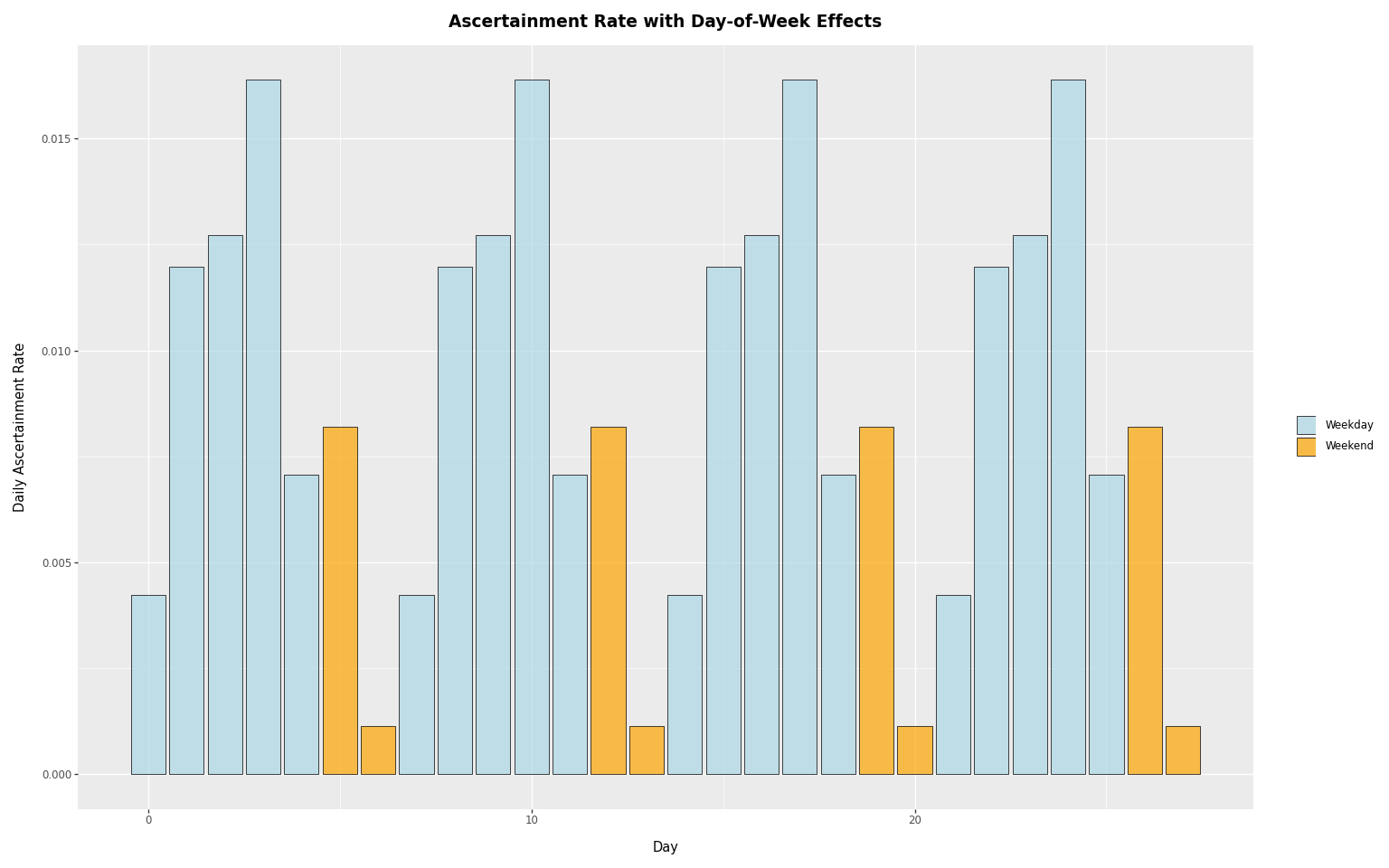
The weekly pattern is clear: weekday rates are higher than weekend rates, reflecting reduced reporting on weekends.
Applying to a simulated observation process
We now use the AscertainmentWithDayOfWeek instance defined above to
generate day-of-week multipliers within a realistic observation
pipeline, showing how a custom RandomVariable integrates into a
data-generating process.
In a hospital surveillance system, the observation pipeline is:
- Infections occur over time (the latent process).
- Delay: each infection leads to a hospital admission after some delay, modeled as a convolution with a delay PMF.
- Reporting: the admission is reported with day-of-week effects — fewer reports on weekends, more on weekdays.
- Noise: observed counts include measurement noise.
The day-of-week effect is a reporting artifact, so it is applied after the delay convolution. We walk through each step explicitly to make the pipeline clear.
# Epidemic curve: exponential growth then decay
n_days = 60
infections = 10000.0 * jnp.exp(-((jnp.arange(n_days) - 25.0) ** 2) / 200.0)
We convolve infections with the delay PMF and apply a baseline ascertainment rate to get the expected admissions before noise:
baseline_rate = 0.01
expected_admissions = jnp.convolve(
    baseline_rate * infections,
    hosp_delay_pmf,
    mode="full",
)[:n_days]
Now we simulate observed admissions with and without day-of-week
effects. Without effects, we add noise directly to the smooth expected
curve. With effects, we first call our custom ascertainment_rv to get
a day-of-week multiplier, apply it to the expected admissions
(post-convolution, at the reporting stage), then add noise.
n_samples = 20
concentration = 50.0

results = []
for seed in range(n_samples):
    with numpyro.handlers.seed(rng_seed=seed):
        # Without day-of-week: noise on the smooth expected curve
        obs_no_dow = numpyro.sample(
            "obs_no_dow",
            dist.NegativeBinomial2(expected_admissions, concentration),
        )

    with numpyro.handlers.seed(rng_seed=seed + 1000):
        # Sample day-of-week multiplier from the custom RV
        (daily_rates,) = ascertainment_rv(n_days=n_days)
        dow_multiplier = daily_rates / daily_rates.mean()

        # Apply day-of-week *after* the delay convolution
        obs_with_dow = numpyro.sample(
            "obs_with_dow",
            dist.NegativeBinomial2(expected_admissions * dow_multiplier, concentration),
        )

    for i in range(n_days):
        results.append(
            {
                "day": i,
                "admissions": float(obs_no_dow[i]),
                "type": "No day-of-week effect",
                "sample": seed,
            }
        )
        results.append(
            {
                "day": i,
                "admissions": float(obs_with_dow[i]),
                "type": "With day-of-week effect",
                "sample": seed,
            }
        )
results_df = pd.DataFrame(results)

(
    p9.ggplot(
        results_df,
        p9.aes(x="day", y="admissions", group="sample"),
    )
    + p9.geom_line(alpha=0.3, size=0.5, color="steelblue")
    + p9.facet_wrap("~ type", ncol=2)
    + p9.labs(
        x="Day",
        y="Hospital Admissions",
        title="Simulated Hospital Admissions",
    )
    + theme_tutorial
)
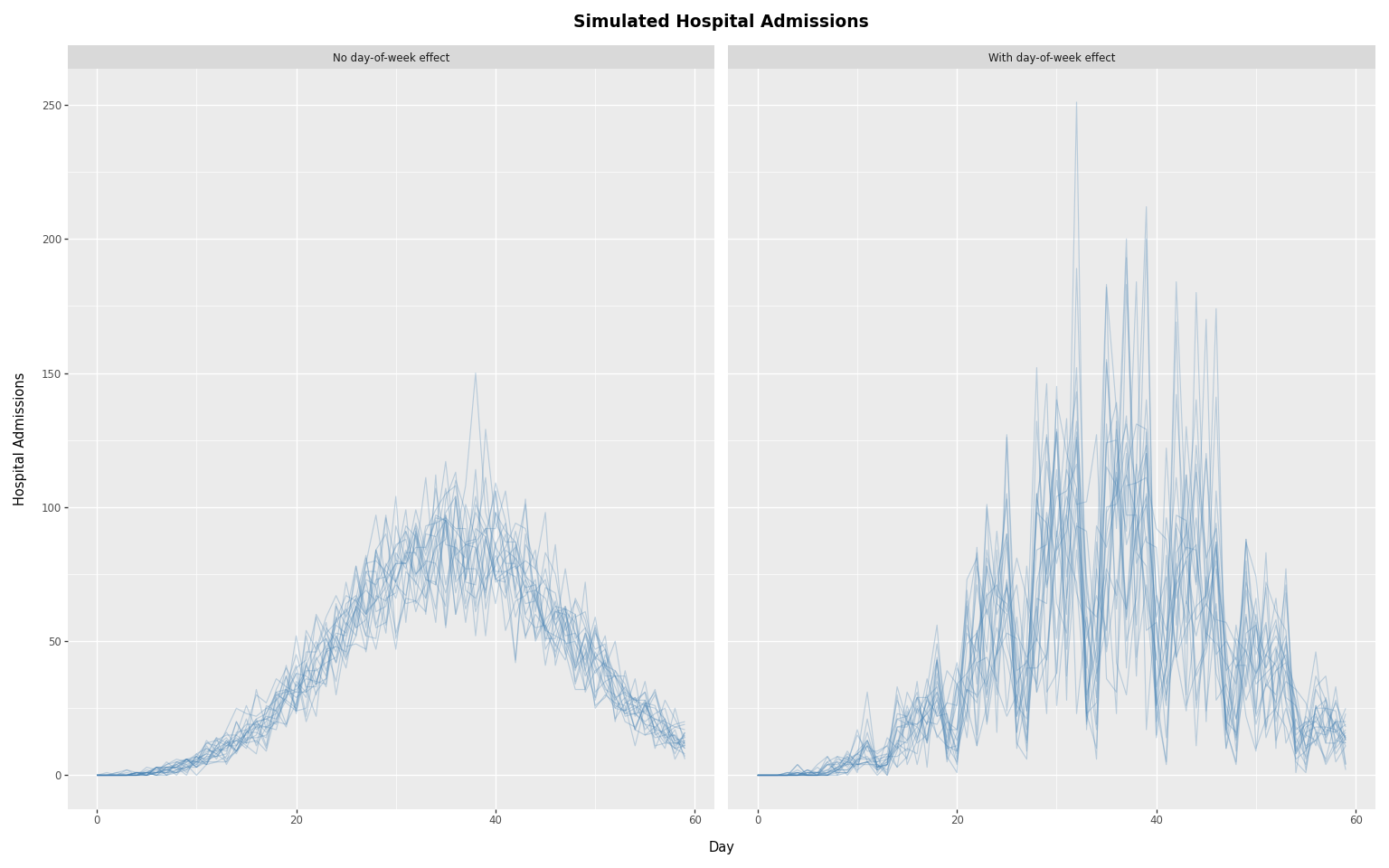
The left panel shows smooth variation from noise alone. The right panel shows the additional weekly oscillation introduced by day-of-week reporting effects — the sawtooth pattern of weekend dips and weekday peaks that is characteristic of real hospital admissions data.
Summary
Choosing a RandomVariable implementation
| Need | Use |
|---|---|
| Fixed known value | DeterministicVariable |
| Fixed known PMF | DeterministicPMF |
| Sample from a fixed distribution | DistributionalVariable (static) |
| Sample from a distribution parameterized at sample time | DistributionalVariable (dynamic, pass a callable) |
| Probability with a Normal prior on its log-odds | LogitNormalVariable |
| Deterministic transformation of another RV | TransformedVariable |
| Multiple sample statements, custom validation, or derived computation | Custom RandomVariable subclass |
Writing a custom RandomVariable
- Subclass
RandomVariablefrompyrenew.metaclass - Implement
sample(**kwargs)returning atuple - Use
numpyro.sample()for quantities to be estimated - Use
numpyro.deterministic()to record derived quantities in the trace - Accept
**kwargsinsample()for composability