Building Multi-Signal Renewal Models
Code
import numpyro

# to run samplers in parallel you must run `set_host_device_count` before importing jax
numpyro.set_host_device_count(4)
numpyro.enable_x64()
Code
import arviz as az
import jax
import jax.numpy as jnp
import jax.random as random
import numpy as np
import numpyro.distributions as dist
import plotnine as p9
import pandas as pd
import time
import warnings
from datetime import date

warnings.filterwarnings("ignore")

from _tutorial_theme import theme_tutorial
Code
from jax.typing import ArrayLike

from pyrenew import datasets
from pyrenew.deterministic import (
    DeterministicPMF,
    DeterministicVariable,
)
from pyrenew.metaclass import RandomVariable
from pyrenew.randomvariable import DistributionalVariable

from pyrenew.latent import (
    SubpopulationInfections,
    DifferencedAR1,
    RandomWalk,
    StepwiseTemporalProcess,
    WeeklyTemporalProcess,
    GammaGroupSdPrior,
    HierarchicalNormalPrior,
)
from pyrenew.model import PyrenewBuilder

from pyrenew.observation import (
    PopulationCounts,
    HierarchicalNormalNoise,
    MeasurementObservation,
    MeasurementNoise,
    NegativeBinomialNoise,
)
from pyrenew.time import MMWR_WEEK
Overview
Renewal models in PyRenew combine two types of components:
-
Latent infection process: Generates unobserved infections via the renewal equation, driven by a time-varying reproduction number \(\mathcal{R}(t)\)
-
Observation processes: Transform latent infections into observable signals (hospital admissions, wastewater concentrations, etc.) by applying delays, ascertainment, and noise
A multi-signal model combines multiple observation processes—each representing a different data stream, e.g., hospital admissions, emergency department visits, wastewater concentrations, which stem from the same underlying latent infection process. By jointly modeling these signals, we can improve estimation and prediction of the time-varying reproduction number \(\mathcal{R}(t)\). Such a model must:
- Generate a single coherent infection trajectory (or set of trajectories for subpopulations)
- Route those infections to each observation process appropriately
- Handle the initialization period required by delay distributions
The PyrenewBuilder class handles this plumbing. You specify:
- A single latent process (e.g.,
SubpopulationInfections) that defines how infections evolve. - One or more observation processes (e.g.,
PopulationCounts,MeasurementObservation) that define how infections become data.
The builder computes initialization requirements, wires components together, and produces a model ready for inference.
Related Tutorials
Before diving into multi-signal models, you may want to review these foundational tutorials:
- Latent Infections and Latent Subpopulation Infections: Understanding temporal process choices for \(\mathcal{R}(t)\)
- Observation Processes: Counts: Modeling count data (admissions, deaths)
- Observation Processes: Measurements: Modeling continuous data (wastewater)
This tutorial shows how to combine these components into a complete multi-signal model.
What This Tutorial Covers
This tutorial demonstrates building a multi-signal renewal model using:
SubpopulationInfections— subpopulations share a jurisdiction-level baseline \(\mathcal{R}(t)\) with subpopulation-specific deviationsPopulationCounts— hospital admissions (jurisdiction-level)- A custom
Wastewaterclass — viral concentrations (subpopulation-level)
Model Structure
In this tutorial, we build a model that jointly fits two data streams to a shared latent infection process:
- Hospital admissions — jurisdiction-level counts that reflect a delayed and partially observed subset of total infections across all subpopulations
- Wastewater concentrations — site-level measurements from a subset of subpopulations (catchment areas), reflecting viral shedding and dilution
The diagram below shows how data flows through the model. The latent process generates infection trajectories for all subpopulations. Each observation process receives the infections it needs — aggregated totals or per-subpopulation arrays — and transforms them into predicted observations via delays, ascertainment, shedding kinetics, and noise.
flowchart TB

    subgraph Latent["Latent Infection Process"]
        L["Renewal equation<br/>(SubpopulationInfections)"]
    end

    subgraph Infections["Infection Trajectories"]
        J["Jurisdiction total<br/>(summed across subpopulations)"]
        S["Per-subpopulation infections<br/>(all subpopulations)"]
    end

    subgraph Obs["Observation Processes"]
        C["Hospital admissions<br/>(PopulationCounts)"]
        W["Wastewater concentrations<br/>(MeasurementObservation)"]
    end

    subgraph Data["Observed Data"]
        HA["Reported admissions"]
        WW["Measured viral concentrations"]
    end

    L --> S
    S -->|"weighted sum"| J
    J --> C
    S -->|"select monitored subpopulations"| W
    C -->|"delay + ascertainment + noise"| HA
    W -->|"shedding + dilution + noise"| WW
Infection Resolution
Different observation processes observe different levels of the model hierarchy. Each observation process declares an infection resolution that determines what infection data it receives:
| Resolution | Receives | Example signals |
|---|---|---|
"aggregate" |
Aggregated infections (sum across all subpopulations), shape (T,) |
Hospital admissions, case counts |
"subpop" |
Infection matrix for all subpopulations, shape (T, n_subpops) |
Wastewater, site-specific surveillance |
The PyrenewBuilder routes latent infections to observation processes
based on each process’s declared resolution.
For subpopulation-level observations, the observation process selects
which subpopulations it observes using subpop_indices provided at
sample/fit time. This allows flexible observation patterns—for example,
wastewater samples might only cover 5 of 6 subpopulations (catchment
areas), while the 6th represents areas without wastewater monitoring.
With this structure in mind, we’ll now define each component following the generative direction: first the latent infection process, then the observation processes.
Latent Infection Process
Latent infection processes implement the renewal equation to generate infection trajectories. All latent processes share common components:
- Generation interval: PMF for secondary infection timing
- Initial infections (\(I(0)\)): Starting condition for the renewal process
- Temporal dynamics: How \(\mathcal{R}(t)\) evolves over time
Generation Interval
The generation interval PMF specifies the probability that a secondary infection occurs \(\tau\) days after the primary infection.
Code
covid_gen_int = [0.16, 0.32, 0.25, 0.14, 0.07, 0.04, 0.02]
gen_int_pmf = jnp.array(covid_gen_int)
gen_int_rv = DeterministicPMF("gen_int", gen_int_pmf)

days = np.arange(len(gen_int_pmf))
print(f"Generation interval: {gen_int_pmf}")
Generation interval: [0.16 0.32 0.25 0.14 0.07 0.04 0.02]
I0: Initial Infections
The initial infections RV I0_rv specifies the proportion of the
population infected at the first observation time. This must be a
value in the interval (0, 1]. We use a Beta prior centered near a small
value:
Code
I0_rv = DistributionalVariable("I0", dist.Beta(1, 100))
Log Rt at time \(0\)
We place a prior on the log \(\mathcal{R}(t)\) at time \(0\), centered at \(0.0\) (\(\mathcal{R}(t) = 1.0\)) with moderate uncertainty:
Code
log_rt_time_0_rv = DistributionalVariable("log_rt_time_0", dist.Normal(0.0, 0.5))
Temporal Processes for \(\mathcal{R}(t)\)
We configure two temporal processes:
- Jurisdiction-level (
baseline_rt_process): DifferencedAR(1) process for the baseline \(\mathcal{R}(t)\) - Subpopulation-level (
subpop_rt_deviation_process): RandomWalk for subpopulation deviations
The RandomWalk allows flexible evolution of subpopulation-specific transmission without mean reversion.
Code
# DifferencedAR1 allows persistent trends while stabilizing the growth rate.
baseline_rt_process = DifferencedAR1(
    autoreg_rv=DeterministicVariable("autoreg", 0.5),
    innovation_sd_rv=DeterministicVariable("innovation_sd", 0.01),
)

# RandomWalk allows flexible subpopulation deviations
subpop_rt_deviation_process = RandomWalk(
    innovation_sd_rv=DeterministicVariable("innovation_sd", 0.025),
)
Choosing the \(\mathcal{R}(t)\) Parameter Cadence
The renewal equation is evaluated on the model’s daily time axis, but the temporal process for \(\mathcal{R}(t)\) does not have to sample a new parameter every day. This separates three model choices:
- Parameter cadence: how often the \(\mathcal{R}(t)\) temporal process samples a new latent value
- Model time axis: the daily axis used by the renewal equation and delay convolutions
- Observation cadence: the temporal granularity for each signal, such as daily ED visits or weekly hospital admissions
The DifferencedAR1 process above samples one value per model day:
baseline_rt_process = DifferencedAR1(
    autoreg_rv=DeterministicVariable("autoreg", 0.5),
    innovation_sd_rv=DeterministicVariable("innovation_sd", 0.01),
)
To use a weekly \(\mathcal{R}(t)\) while still running the renewal
equation daily, wrap the temporal process in WeeklyTemporalProcess.
The wrapper samples a weekly trajectory and broadcasts it to the daily
model axis before the latent infection process uses it.
weekly_baseline_rt_process = WeeklyTemporalProcess(
    inner=DifferencedAR1(
        autoreg_rv=DeterministicVariable("autoreg", 0.5),
        innovation_sd_rv=DeterministicVariable("innovation_sd", 0.01),
    ),
    start_dow=MMWR_WEEK,
)
Use WeeklyTemporalProcess when the weekly Rt blocks should align to a
calendar week. The start_dow parameter is the day of week on which the
calendar-week cycle begins (0=Monday, 6=Sunday, ISO convention).
pyrenew.time exports MMWR_WEEK = 6 (Sunday-Saturday epiweeks) and
ISO_WEEK = 0 (Monday-Sunday); pass any integer in [0, 6] for other
conventions. At sample or run time, pass the date of the first
observation day as obs_start_date. Argument obs_start_date is
required whenever any component performs calendar-aligned work: a
WeeklyTemporalProcess, a count observation with
aggregation="weekly", or any observation with a day-of-week effect.
For StepwiseTemporalProcess and daily observations with no day-of-week
effect, obs_start_date can be omitted. The model handles the calendar
bookkeeping and forwards the day-of-week information to every component
that needs it.
Observation Processes
Observation processes transform latent infections into observable signals and define the statistical model linking predictions to data. Each observation process:
- Has a unique name that identifies the signal in model outputs
- Declares what infection resolution it needs (
"aggregate"or"subpop") - Applies signal-specific transformations (ascertainment, delay convolution, shedding kinetics)
- Defines the noise model
Signal Naming
Each observation process requires a name parameter—a short, meaningful
identifier like "hospital" or "wastewater". This name serves as the
single identifier for the signal throughout the model:
- Numpyro sites: Prefixes all sample and deterministic sites (e.g.,
hospital_obs,hospital_predicted) - Data binding: Becomes the keyword argument for passing data to
model.run()(e.g.,hospital={...})
This unified naming provides several benefits:
- Interpretable outputs: When examining MCMC samples or posterior
diagnostics, site names like
hospital_predictedimmediately indicate which signal each quantity refers to - Multiple signals of the same type: You can include multiple count observations (e.g., hospital admissions and deaths) by giving each a distinct name
- Clearer debugging: Error messages and trace inspection show meaningful signal names rather than generic identifiers
Hospital Admissions
In this example we use a dataset consisting of hospital admissions for COVID-19 across California for the first 10 months of 2023 (as reported to the CDC).
Code
# Load daily hospital admissions for California
ca_hosp_data = datasets.load_hospital_data_for_state("CA", "2023-11-06.csv")
obs_start_date = ca_hosp_data["dates"][0]
hosp_admits = ca_hosp_data["daily_admits"]
population_size = ca_hosp_data["population"]
n_hosp_days = ca_hosp_data["n_days"]

print("State: California")
print(f"Population: {population_size:,}")
print(f"Date range: {ca_hosp_data['dates'][0]} to {ca_hosp_data['dates'][-1]}")
print(f"Number of days: {n_hosp_days}")
print(f"Admissions range: {int(hosp_admits.min())} to {int(hosp_admits.max())}")
State: California
Population: 39,512,223
Date range: 2023-01-01 to 2023-11-06
Number of days: 310
Admissions range: 2 to 2574
The hospital admissions data is aggregated at the jurisdiction level,
therefore we specify a PopulationCounts observation process.
Code
# Infection-to-hospitalization delay (COVID-19, from literature)
inf_to_hosp_pmf = jnp.array(
    [
        0,
        0.00469,
        0.01452,
        0.02786,
        0.04237,
        0.05581,
        0.06657,
        0.07379,
        0.07729,
        0.07737,
        0.07465,
        0.06988,
        0.06377,
        0.05696,
        0.04996,
        0.04315,
        0.03677,
        0.03097,
        0.02583,
        0.02135,
        0.01751,
        0.01427,
        0.01156,
        0.00931,
        0.00746,
        0.00596,
        0.00474,
        0.00375,
        0.00296,
        0.00233,
        0.00183,
        0.00143,
        0.00107,
        0.00077,
        0.00054,
        0.00036,
        0.00024,
        0.00015,
        0.00009,
        0.00005,
        0.00003,
        0.00002,
        0.00001,
    ]
)
hosp_delay_rv = DeterministicPMF("inf_to_hosp_delay", inf_to_hosp_pmf)

# IHR: ~1% of infections lead to hospitalization
ihr_rv = DeterministicVariable("ihr", 0.01)

# Negative binomial concentration (moderate overdispersion)
hosp_concentration_rv = DeterministicVariable("hosp_concentration", 10.0)

# Create hospital observation process
hosp_obs = PopulationCounts(
    name="hospital",
    ascertainment_rate_rv=ihr_rv,
    delay_distribution_rv=hosp_delay_rv,
    noise=NegativeBinomialNoise(hosp_concentration_rv),
)

print("Hospital observation:")
print(f"  Infection resolution: {hosp_obs.infection_resolution()}")
print(f"  Delay PMF length: {len(inf_to_hosp_pmf)} days")
Hospital observation:
  Infection resolution: aggregate
  Delay PMF length: 43 days
Wastewater Concentrations
Wastewater Observation Process
The MeasurementObservation base class handles continuous observation
processes. Domain-specific implementations subclass it and implement
_predicted_obs() to transform infections into predicted values. See
observation_processes_measurements.md for a detailed tutorial.
Code
class Wastewater(MeasurementObservation):
    """
    Wastewater viral concentration observation process.

    Transforms site-level infections into predicted log-concentrations
    via shedding kinetics convolution and genome/volume scaling.
    """

    def __init__(
        self,
        name: str,
        shedding_kinetics_rv: RandomVariable,
        log10_genome_per_infection_rv: RandomVariable,
        ml_per_person_per_day: float,
        noise: MeasurementNoise,
    ) -> None:
        super().__init__(name=name, temporal_pmf_rv=shedding_kinetics_rv, noise=noise)
        self.log10_genome_per_infection_rv = log10_genome_per_infection_rv
        self.ml_per_person_per_day = ml_per_person_per_day

    def validate(self) -> None:
        shedding_pmf = self.temporal_pmf_rv()
        self._validate_pmf(shedding_pmf, "shedding_kinetics_rv")
        self.noise.validate()

    def lookback_days(self) -> int:
        return len(self.temporal_pmf_rv()) - 1

    def _predicted_obs(self, infections: ArrayLike) -> ArrayLike:
        shedding_pmf = self.temporal_pmf_rv()
        log10_genome = self.log10_genome_per_infection_rv()

        def convolve_site(site_infections):
            convolved, _ = self._convolve_with_alignment(
                site_infections, shedding_pmf, p_observed=1.0
            )
            return convolved

        shedding_signal = jax.vmap(convolve_site, in_axes=1, out_axes=1)(infections)
        genome_copies = 10**log10_genome
        concentration = shedding_signal * genome_copies / self.ml_per_person_per_day
        return jnp.log(concentration)
Wastewater Data
For the wastewater data, we use a simulated dataset for California with realistic noise patterns that covers the same time period.
Code
# Load wastewater data for California
ca_ww_data = datasets.load_wastewater_data_for_state("CA", "fake_nwss.csv")

ww_conc = ca_ww_data["observed_conc"]  # log concentrations
ww_site_ids = ca_ww_data["site_ids"]
ww_time_indices = ca_ww_data["time_indices"]
ww_n_sites = ca_ww_data["n_sites"]
ww_n_obs = ca_ww_data["n_obs"]
ww_wwtp_names = ca_ww_data["wwtp_names"]

print("State: California")
print(f"Number of sites: {ww_n_sites}")
print(f"Number of observations: {ww_n_obs}")
print(f"Date range: {ca_ww_data['dates'][0]} to {ca_ww_data['dates'][-1]}")
print(f"Time index range: {int(ww_time_indices.min())} to {int(ww_time_indices.max())}")
print("\nSites:")
for i, name in enumerate(ww_wwtp_names[:5]):
    print(f"  {i}: {name}")
if ww_n_sites > 5:
    print(f"  ... and {ww_n_sites - 5} more")
State: California
Number of sites: 5
Number of observations: 1495
Date range: 2023-01-01 to 2023-11-06
Time index range: 0 to 309

Sites:
  0: 1
  1: 2
  2: 3
  3: 4
  4: 5
Wastewater observations are site-level: each measurement is associated
with a specific measurement site. The Wastewater observation process
uses LogNormalNoise, which takes hierarchical priors for the
site-level mode and standard deviation parameters. This enables partial
pooling across measurement sites.
Here we specify HierarchicalNormalPrior for the site-level mode and
GammaGroupSdPrior for the standard deviation.
Code
# Viral shedding kinetics PMF (days post-infection)
shedding_pmf = jnp.array(
    [
        0.0,
        0.02,
        0.08,
        0.15,
        0.20,
        0.18,
        0.14,
        0.10,
        0.06,
        0.04,
        0.02,
        0.01,
    ]
)
shedding_pmf = shedding_pmf / shedding_pmf.sum()  # normalize
shedding_rv = DeterministicPMF("shedding_kinetics", shedding_pmf)

# Log10 genomes shed per infection
log10_genome_rv = DeterministicVariable("log10_genome_per_inf", 9.0)

# Wastewater volume per person per day (mL)
ml_per_person_per_day = 1000.0

# Hierarchical priors for site-level effects
site_mode_prior = HierarchicalNormalPrior(
    "ww_site_mode", sd_rv=DeterministicVariable("site_mode_sd", 0.5)
)
site_sd_prior = GammaGroupSdPrior(
    "ww_site_sd",
    sd_mean_rv=DeterministicVariable("site_sd_mean", 0.3),
    sd_concentration_rv=DeterministicVariable("site_sd_conc", 4.0),
)

# Create wastewater observation process
ww_obs = Wastewater(
    name="wastewater",
    shedding_kinetics_rv=shedding_rv,
    log10_genome_per_infection_rv=log10_genome_rv,
    ml_per_person_per_day=ml_per_person_per_day,
    noise=HierarchicalNormalNoise(site_mode_prior, site_sd_prior),
)

print("Wastewater observation:")
print(f"  Infection resolution: {ww_obs.infection_resolution()}")
print(f"  Shedding PMF length: {len(shedding_pmf)} days")
Wastewater observation:
  Infection resolution: subpop
  Shedding PMF length: 12 days
Model Building
We instantiate a PyrenewBuilder object which handles the composition
of the latent infection process and the observation process.
Code
# Build the multi-signal model
builder = PyrenewBuilder()
The PyrenewBuilder object has 3 key methods:
configure_latentadd_observationbuild
Methods configure_latent and add_observation can be called in any
order. Method build is called once all processes have been specified
in the model.
Configuring the Latent Process
We use configure_latent to specify the model structure: generation
interval, initial infections, and temporal dynamics.
Code
print("Latent process configuration:")
print(f"  Generation interval length: {len(gen_int_rv())} days")

builder.configure_latent(
    SubpopulationInfections,
    gen_int_rv=gen_int_rv,
    I0_rv=I0_rv,
    log_rt_time_0_rv=log_rt_time_0_rv,
    baseline_rt_process=baseline_rt_process,
    subpop_rt_deviation_process=subpop_rt_deviation_process,
)
Latent process configuration:
  Generation interval length: 7 days

<pyrenew.model.pyrenew_builder.pyrenewbuilder 0x7f5814140050="" at="">
Specifying the Observation Processes, Data
Each observation process’s name attribute becomes the keyword used to
pass that observation’s data to model.run() (e.g., hospital={...},
wastewater={...}).
Code
builder.add_observation(hosp_obs)  # Uses hosp_obs.name = "hospital"
builder.add_observation(ww_obs)  # Uses ww_obs.name = "wastewater"
model = builder.build()

n_init = model.latent.n_initialization_points
print("Model built successfully")
print(f"  n_initialization_points: {n_init}")
print(f"  Latent process: {type(model.latent).__name__}")
print(f"  Observation processes: {list(model.observations.keys())}")
Model built successfully
  n_initialization_points: 42
  Latent process: SubpopulationInfections
  Observation processes: ['hospital', 'wastewater']
Model Identifiability.
The renewal equation is linear in the initial infections I0_rv, so
scaling I0_rv by a factor \(c\) scales the entire infection trajectory
by \(c\). In practice, I0_rv is weakly identified because each
observation process links infections to data through a signal-specific
ascertainment rate \(\alpha_s\) — the probability that an infection is
observed as an event in signal \(s\). Doubling I0_rv while halving all
ascertainment rates produces identical expected observations. Without
external information to anchor either the ascertainment rates or the
absolute infection level, the data cannot distinguish “more infections,
lower ascertainment” from “fewer infections, higher ascertainment.” The
priors on I0_rv and on the ascertainment rates resolve this ambiguity.
Fitting the Model to Data: model.run()
When you call model.run(), you supply three types of information:
- Model and population information — the fitting period, total population size, and subpopulation fractions
- Observation data — one data dictionary per registered observation process
- MCMC controls — basic settings for posterior sampling
For this model, a complete call has the following structure:
model.run(
    num_warmup=500,
    num_samples=500,
    rng_key=random.PRNGKey(42),
    mcmc_args={"num_chains": 4, "progress_bar": False},
    n_days_post_init=n_days,
    population_size=population_size,
    subpop_fractions=subpop_fractions,
    **obs_data,
)
samples = model.mcmc.get_samples()
The **obs_data dictionary supplies the observation start date and one
data dictionary per observation process. The keys of the observation
dictionaries are the names registered on the builder: hospital and
wastewater.
Model Time vs. Observation Time
In the raw data, day 0 is the first day with observations. PyRenew adds an initialization period before this date so the renewal process has enough past infections to generate infections during the observed period.
This means the model has two related time scales:
- Observation time starts at the first day in the data.
- Model time starts
n_initdays earlier.
On the model time axis, indices 0 through n_init - 1 are
initialization days. The first observed day is model index n_init, and
the last observed day is model index n_init + n_days - 1.
The model provides helper methods to convert observation data onto this model time axis:
model.pad_observations(obs)prependsn_initNaN values to dense daily observation vectors.model.shift_times(times)addsn_initto sparse observation time indices.
The hospital admissions signal is dense: it has one value per observation day, so we pad it. The wastewater signal is sparse: each row has an observation day, so we shift its time index.
Population Structure
First we declare the population structure. We have 6 subpopulations, where 5 have wastewater monitoring and 1 does not. The subpopulations with wastewater monitoring need not be contiguous indices; they can be any subset of {0, 1, …, n_subpops-1}.
Code
# All 6 subpopulations with their population fractions
subpop_fractions = jnp.array([0.10, 0.14, 0.21, 0.22, 0.07, 0.26])

n_subpops = len(subpop_fractions)

# Which subpopulations have wastewater monitoring?
# These indices will be used in subpop_indices for wastewater observations.
# They can be any subset of {0, 1, ..., n_subpops-1}, not necessarily contiguous.
ww_monitored_subpops = jnp.array(
    [0, 1, 2, 3, 4]
)  # subpop 5 has no wastewater monitoring

print(f"Total subpopulations: {n_subpops}")
print(f"Subpopulations with wastewater monitoring: {list(ww_monitored_subpops)}")
print(
    f"Wastewater coverage: {float(jnp.sum(subpop_fractions[ww_monitored_subpops])):.0%}"
)
print(f"Total population: {float(jnp.sum(subpop_fractions)):.0%}")
Total subpopulations: 6
Subpopulations with wastewater monitoring: [Array(0, dtype=int64), Array(1, dtype=int64), Array(2, dtype=int64), Array(3, dtype=int64), Array(4, dtype=int64)]
Wastewater coverage: 74%
Total population: 100%
The subpop_fractions array defines all subpopulations in the latent
infection process, and its entries must sum to 1.0. Which subpopulations
each observation process sees is determined by the observation data.
Measurement data typically exhibits sensor-level variability: different
instruments, labs, or sampling locations may have systematic biases and
different precision levels. The wastewater observations record both the
wastewater treatment plant from which the sample was collected and the
laboratory at which the sample was processed. For wastewater, a “sensor”
is a WWTP/lab pair - the combination of treatment plant and laboratory
associated with sensor-specific bias and measurement variability.
Because the wastewater component’s HierarchicalNormalNoise samples one
mode and one standard deviation parameter. Therefore, the wastewater
signal’s data dictionary includes:
subpop_indiceslinks each observation to the appropriate subpopulationsensor_indicesselects the sensor-specific noise parameters.n_sensorsthe total number of sensors, used to size the sensor-level noise parameters.
Preparing Observation Data
The observation data dictionary is structured to match the keyword
arguments of model.run(): obs_start_date at the top level, plus one
sub-dictionary per observation process. The entries in the
sub-dictionaries are forwarded as arguments to each observation
process’s sample method.
[!WARNING]
Nest observation-specific arguments under the signal name
Arguments such as
subpop_indicesmust be placed inside the dictionary for the corresponding registered observation process. Passing them at the top level does not associate them with that signal and raises a validation error before MCMC begins.# Correct: observation-specific metadata is nested under the signal name. model.run( ..., regional_counts={ "obs": counts, "subpop_indices": subpop_indices, }, ) # Incorrect: this top-level argument is not associated with regional_counts. model.run( ..., regional_counts={"obs": counts}, subpop_indices=subpop_indices, )
The two observation streams are aligned differently because they are
represented differently. Hospital admissions are a dense daily series:
every day in the fitting window has a position in the vector, so
model.pad_observations() prepends n_init missing values for the
initialization period. Wastewater measurements are sparse rows: only
sampled days appear in the table, so the observations themselves are not
padded. Instead, model.shift_times() adds n_init to each wastewater
time index so those rows point to the correct days on the model’s shared
time axis.
Code
n_days_90 = 90

# Hospital: dense, NaN-padded to length n_total
hosp_obs = model.pad_observations(hosp_admits[:n_days_90])

# Wastewater: sparse, times shifted to shared axis
ww_mask = ca_ww_data["time_indices"] < n_days_90
ww_times = model.shift_times(ca_ww_data["time_indices"][ww_mask])
ww_conc = ca_ww_data["observed_conc"][ww_mask]
ww_sites = ca_ww_data["site_ids"][ww_mask]

# Map wastewater sensors to subpopulation indices.
# In practice, this mapping comes from your data
# (which WWTP serves which catchment). For this demo, we cycle
# sensors through the monitored subpopulations.
n_ww_sites = ca_ww_data["n_sites"]
n_monitored = len(ww_monitored_subpops)
sensor_to_subpop = {
    i: int(ww_monitored_subpops[i % n_monitored]) for i in range(n_ww_sites)
}
ww_subpop_indices = jnp.array([sensor_to_subpop[int(s)] for s in ww_sites])

obs_data_90 = {
    "obs_start_date": obs_start_date,
    "hospital": {
        "obs": hosp_obs,
    },
    "wastewater": {
        "obs": ww_conc,
        "times": ww_times,
        "subpop_indices": ww_subpop_indices,
        "sensor_indices": ww_sites,
        "n_sensors": n_ww_sites,
    },
}
The observation dictionary has the following structure:
{
    "obs_start_date": ...,
    "hospital": {
        "obs": ...
    },
    "wastewater": {
        "obs": ...
        "times": ...
        "subpop_indices": ...
        "sensor_indices": ...
        "n_sensors": ...
    },
}
At call time, we unpack this dictionary with **, forwarding each entry
as a keyword argument to model.run(). Note that we could also have
manually passed each dictionary entry to model.run(). We chose to
create (and then unpack) an obs_data dictionary to keep our data
organized in one place.
MCMC Controls
model.run() uses NumPyro’s No-U-Turn Sampler (NUTS) through
numpyro.infer.MCMC. For this introductory example, the main controls
are:
num_warmup, the number of warmup iterationsnum_samples, the number of posterior samples to keeprng_key, the random seed for samplingmcmc_args, optional NumPyro MCMC settings
For this fit, we use 4 chains and turn off the progress bar:
mcmc_args = {"num_chains": 4, "progress_bar": False}
See the NumPyro MCMC reference for more advanced MCMC options.
Running the Model
We now unpack the observation dictionary prepared above into
model.run(). The fit uses 90 days of data.
Fit: 90 Days
Code
# Clear JAX caches to avoid interference from earlier cells
jax.clear_caches()

print(f"Fitting model with {n_days_90} days of data...")
print("  This may take a few minutes...")

start_time = time.time()
model.run(
    num_warmup=500,
    num_samples=500,
    rng_key=random.PRNGKey(42),
    mcmc_args={"num_chains": 4, "progress_bar": False},
    n_days_post_init=n_days_90,
    population_size=population_size,
    subpop_fractions=subpop_fractions,
    **obs_data_90,
)
# JAX uses asynchronous dispatch, so we must block until sampling completes
# to get accurate timing
samples_90 = model.mcmc.get_samples()
jax.block_until_ready(samples_90)
elapsed_90 = time.time() - start_time
print(f"Elapsed time: {elapsed_90:.1f} seconds")
Fitting model with 90 days of data...
  This may take a few minutes...
Elapsed time: 103.0 seconds
We use ArviZ to assess MCMC
convergence and mixing via the \(\hat{R}\) statistic and effective sample
size (ESS). Before running these diagnostics, we trim the first n_init
time steps from all time-series variables. Since the model cannot
estimate latent infections until it has seen a full generation
interval’s worth of data, these early time steps have no meaningful
epidemiological interpretation and therefore should be excluded from
summaries and visualizations.
Code
def trim_time(ds):
    """Trim first n_init entries from time dimension and reindex."""
    if "time" in ds.dims:
        ds = ds.isel(time=slice(n_init, None))
        ds = ds.assign_coords(time=range(ds.sizes["time"]))
    return ds
We first label the time axis of all time-series variables using the dims
argument to
az.from_numpyro.
Then we trim the first n_init time steps from all time-series
variables. Finally we call the
az.summary
report.
Code
idata_90 = az.from_numpyro(
    model.mcmc,
    dims={
        "latent_infections": ["time"],
        "SubpopulationInfections::infections_aggregate": ["time"],
        "SubpopulationInfections::log_rt_baseline": ["time", "dummy"],
        "SubpopulationInfections::rt_baseline": ["time", "dummy"],
        "SubpopulationInfections::rt_subpop": ["time", "subpop"],
        "SubpopulationInfections::subpop_deviations": ["time", "subpop"],
        "latent_infections_by_subpop": ["time", "subpop"],
        "hospital_predicted": ["time"],
        "wastewater_predicted": ["time", "subpop"],
    },
)

idata_90_trimmed = idata_90.map_over_datasets(trim_time)
az.summary(idata_90_trimmed, var_names=["latent_infections", "hospital_predicted"])
| mean | sd | eti89_lb | eti89_ub | ess_bulk | ess_tail | r_hat | mcse_mean | mcse_sd | |
|---|---|---|---|---|---|---|---|---|---|
| latent_infections[0] | 5e+04 | 6e+03 | 44000 | 62000 | 2007 | 1678 | 1.01 | 130 | 93 |
| latent_infections[1] | 5e+04 | 5e+03 | 42000 | 60000 | 2018 | 1764 | 1.00 | 120 | 90 |
| latent_infections[2] | 5e+04 | 5e+03 | 44000 | 61000 | 2084 | 1667 | 1.00 | 120 | 86 |
| latent_infections[3] | 5e+04 | 5e+03 | 46000 | 63000 | 1264 | 1264 | 1.01 | 150 | 110 |
| latent_infections[4] | 6e+04 | 6e+03 | 50000 | 69000 | 317 | 703 | 1.02 | 290 | 210 |
| ... | ... | ... | ... | ... | ... | ... | ... | ... | ... |
| hospital_predicted[85] | 1623 | 150 | 1400 | 1900 | 1940 | 1883 | 1.00 | 3.4 | 2.7 |
| hospital_predicted[86] | 1680 | 171 | 1400 | 2000 | 1977 | 2055 | 1.00 | 3.8 | 3.1 |
| hospital_predicted[87] | 1741 | 197 | 1500 | 2100 | 2075 | 2037 | 1.00 | 4.3 | 3.5 |
| hospital_predicted[88] | 1806 | 230 | 1500 | 2200 | 2228 | 2038 | 1.00 | 4.9 | 4 |
| hospital_predicted[89] | 2e+03 | 271 | 1500 | 2400 | 2427 | 2081 | 1.00 | 5.6 | 4.6 |
180 rows × 9 columns
We extract the posterior quantiles and print summary statistics.
Code
latent_inf = idata_90_trimmed.posterior["latent_infections"]

quantiles_90 = {
    "q05": latent_inf.quantile(0.05, dim=["chain", "draw"]).values,
    "q50": latent_inf.quantile(0.50, dim=["chain", "draw"]).values,
    "q95": latent_inf.quantile(0.95, dim=["chain", "draw"]).values,
}

ci_width_90 = quantiles_90["q95"] - quantiles_90["q05"]
print(f"Posterior summary for {n_days_90} days:")
print(f"  Mean 90% CI width: {ci_width_90.mean():,.0f} infections")
print(f"  Median infections (day 45): {quantiles_90['q50'][45]:,.0f}")
Posterior summary for 90 days:
  Mean 90% CI width: 59,233 infections
  Median infections (day 45): 98,637
Finally, we visualize the posterior latent infections alongside observed hospitalizations. Note that hospital admissions lag behind infections by the infection-to-hospitalization delay (mode ~10 days in our delay PMF). When comparing the two panels, peaks in the infection curve should precede corresponding peaks in hospitalizations by roughly 10-14 days.
Code
# Visualize posterior latent infections and observed hospitalizations (90 days)
# Create separate dataframes for faceted plot
infections_df_90 = pd.DataFrame(
    {
        "day": np.arange(n_days_90),
        "median": quantiles_90["q50"],
        "q05": quantiles_90["q05"],
        "q95": quantiles_90["q95"],
        "signal": "Latent Infections",
    }
)

# Add 14-day moving average to smooth noisy daily admissions
hosp_raw_90 = np.array(hosp_admits[:n_days_90], dtype=float)
hosp_ma_90 = pd.Series(hosp_raw_90).rolling(window=14, center=True).mean().values

hosp_df_90 = pd.DataFrame(
    {
        "day": np.arange(n_days_90),
        "median": hosp_ma_90,
        "raw": hosp_raw_90,
        "q05": np.nan,
        "q95": np.nan,
        "signal": "Hospital Admissions (14-day MA)",
    }
)

plot_df_90 = pd.concat([infections_df_90, hosp_df_90], ignore_index=True)
plot_df_90["signal"] = pd.Categorical(
    plot_df_90["signal"],
    categories=["Hospital Admissions (14-day MA)", "Latent Infections"],
    ordered=True,
)

(
    p9.ggplot(plot_df_90, p9.aes(x="day"))
    + p9.geom_ribbon(
        p9.aes(ymin="q05", ymax="q95"),
        fill="steelblue",
        alpha=0.3,
    )
    + p9.geom_point(
        p9.aes(y="raw"),
        color="gray",
        alpha=0.3,
        size=1,
    )
    + p9.geom_line(
        p9.aes(y="median"),
        color="darkblue",
        size=1,
    )
    + p9.facet_wrap("~signal", ncol=1, scales="free_y")
    + p9.scale_y_log10()
    + p9.labs(
        x="Day",
        y="Count",
        title="Posterior Latent Infections vs Observed Hospitalizations (90 days)",
    )
    + theme_tutorial
)
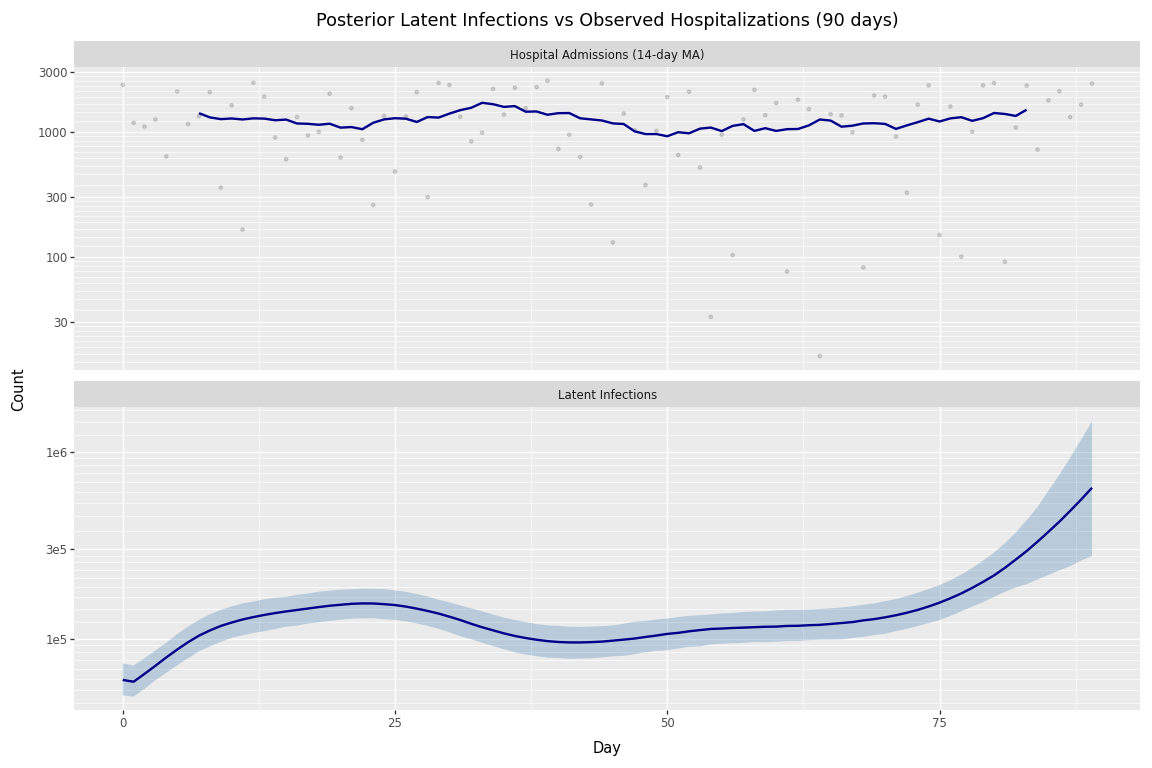
Figure 1: Posterior latent infections and observed hospitalizations (90 days).
Month-by-month uncertainty
The posterior ribbon above shows the infection trajectory and its 90% credible interval, but the ribbon width itself is hard to compare across days. To focus directly on uncertainty, we compute the daily 90% interval width and summarize it over each 30-day period.
Code
ci_width_90 = quantiles_90["q95"] - quantiles_90["q05"]

ci_width_df = pd.DataFrame(
    {
        "day": np.arange(n_days_90),
        "ci_width": ci_width_90,
        "period": pd.cut(
            np.arange(n_days_90),
            bins=[-1, 29, 59, 89],
            labels=["Days 0-29", "Days 30-59", "Days 60-89"],
        ),
    }
)

period_summary_df = (
    ci_width_df.groupby("period", observed=True)
    .agg(
        start=("day", "min"),
        end=("day", "max"),
        mean_ci_width=("ci_width", "mean"),
    )
    .reset_index()
)

print("\nMean 90% interval width by time period:")
for row in period_summary_df.itertuples(index=False):
    print(f"  {row.period}: {row.mean_ci_width:,.0f}")

(
    p9.ggplot(ci_width_df, p9.aes(x="day", y="ci_width"))
    + p9.geom_line(color="gray", alpha=0.6, size=0.7)
    + p9.geom_segment(
        data=period_summary_df,
        mapping=p9.aes(
            x="start",
            xend="end",
            y="mean_ci_width",
            yend="mean_ci_width",
            color="period",
        ),
        size=1.6,
    )
    + p9.scale_y_log10()
    + p9.labs(
        x="Day",
        y="90% interval width",
        color="Period",
        title="Posterior uncertainty in latent infections over the 90-day fit",
    )
    + theme_tutorial
)
Mean 90% interval width by time period:
  Days 0-29: 36,025
  Days 30-59: 33,672
  Days 60-89: 108,001
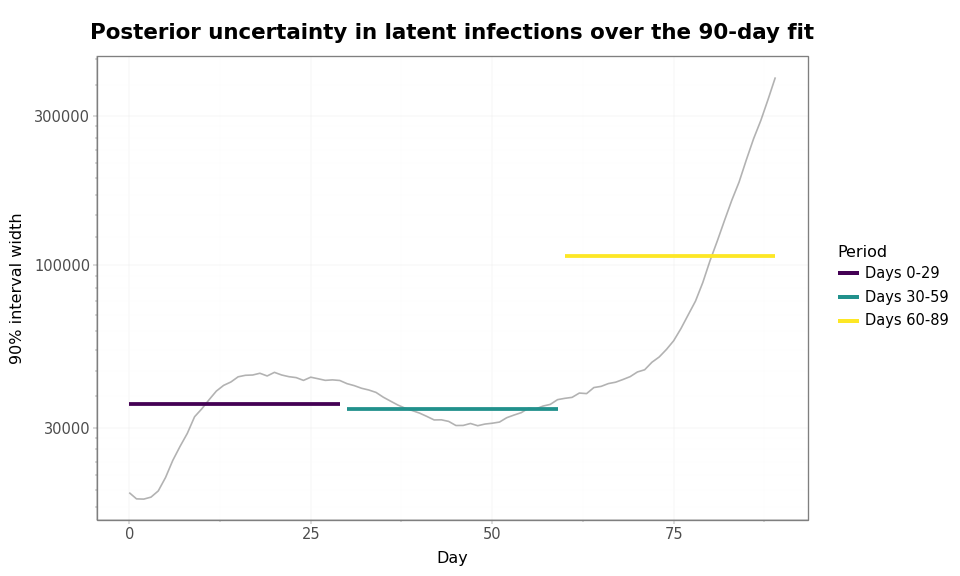
This pattern has a direct implication for forecasting: renewal models are most uncertain at the edge of the observation window. The daily line shows local changes in posterior uncertainty, while the monthly means make the broader edge effect easier to see. Future observations constrain past latent infections through the renewal equation and observation delays, but the most recent days have less future signal available to anchor them. That edge uncertainty is the same uncertainty that carries forward when the model is used for forecasting.
Summary
In this tutorial, we built a renewal model that combines hospital admissions and wastewater concentrations through a shared latent infection process. The latent process describes infections through time and across subpopulations; each observation process describes how one data stream is generated from those infections.
The main workflow was:
- Configure the latent infection process with
configure_latent. - Add named observation processes with
add_observation. - Build the model with
build. - Prepare observation dictionaries whose keys match the observation process names.
- Fit the model with
model.run.
A few details are especially important when adapting this pattern:
- Observation process names become the data argument names passed to
model.run, such ashospital={...}andwastewater={...}. - Dense daily observations are padded with
model.pad_observations. - Sparse observations use shifted time indices from
model.shift_times. subpop_fractionsdefines the latent subpopulations;subpop_indicestells an observation process which subpopulation each measurement observes.- The model time axis starts before the first observed day because PyRenew adds an initialization period for the renewal process.
The 90-day fit shows why the end of the observation window matters. Future observations help constrain past latent infections, so posterior uncertainty is usually largest near the most recent observed days. That same edge uncertainty is what carries forward when the model is used for forecasting.
Next Steps
- Explore different temporal processes for \(\mathcal{R}(t)\) in the Latent Infections and Latent Subpopulation Infections tutorials
- Learn about count-based observation models in Observation Processes: Counts
- Learn about continuous measurement models in Observation Processes: Measurements