Compartmental models
This example builds compartmental models with AlgebraicEpiMech and solves them as ODEs. A model
is a Petri net typed over an epidemiological type system: species are compartments, transitions
are the flows between them. In this example, we won't focus on model composition, but the typing
is what lets models be composed later (see Stratified models).
Drawing the nets with to_graphviz needs the
Graphviz dot executable on the PATH.
using AlgebraicEpiMech
using AlgebraicPetri
using Catlab
using CairoMakie
using LabelledArrays
using OrdinaryDiffEqTsit5
using SymbolicIndexingInterface: SymbolCache
A simple SIR model
create_model pairs a typing with a model template and returns a typed Petri net, a morphism
\(P \to P_{\text{type}}\) from the model into the type system.
From this morphism, we can recover the domain of the typed Petri net, which represents the actual model itself.
As mentioned elsewhere, we can think of the "types" as like a structure preserving "join key" in loose
analogy to a database join key.
For one model on its own the typing is redundant, but it is what makes composition with other models over
the same typing well-defined.
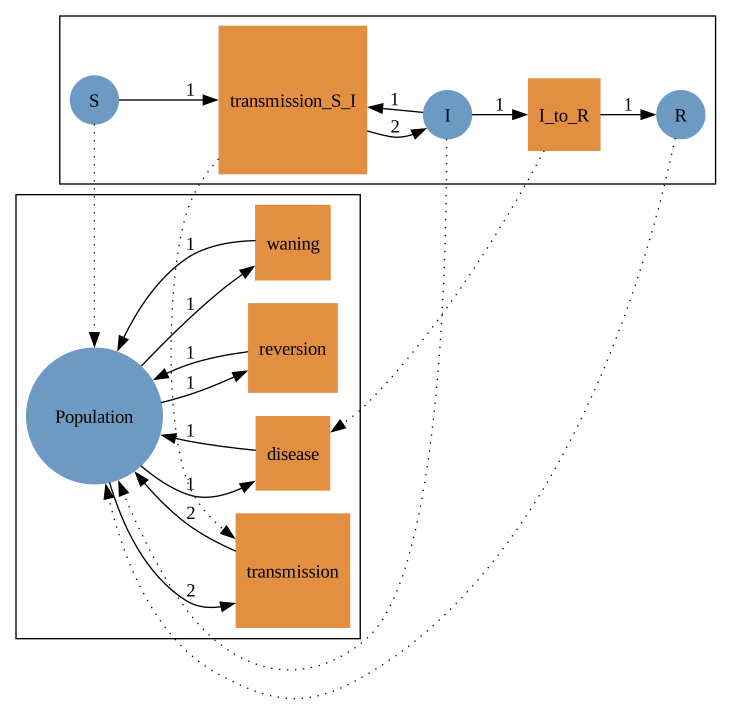
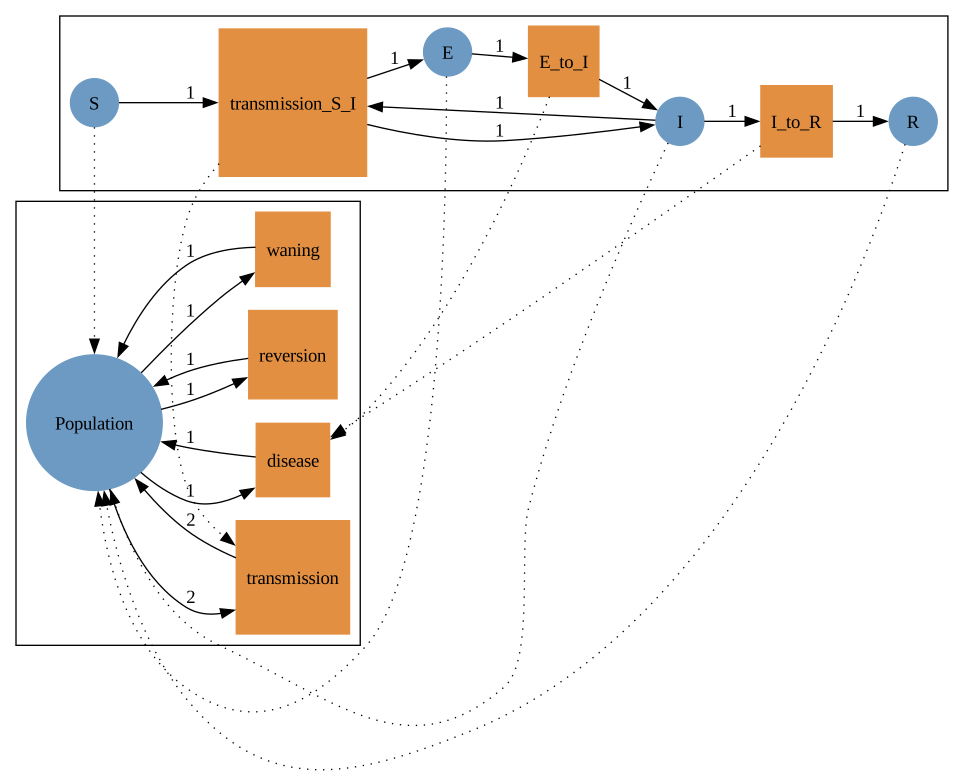
How should we interpret the diagrams?
Both diagrams are petri nets with,
- Circles are species, which are numbers of individuals.
- Boxes are transitions and have one rate parameter each.
Solid arrow number labels are stoichiometric coefficients. We can then use these diagrams to read
the mass-action kinetics of the model: each transition fires at its rate times the product of its inputs,
and moves individuals from inputs to outputs. Transmission, for example, consumes one S and one I
and produces two I, so it fires at transmission_S_I * S * I and changes S by -1 and I by +1.
Note that the domain of the typed net is a petri-net describing the model itself, the codomain is the type system.
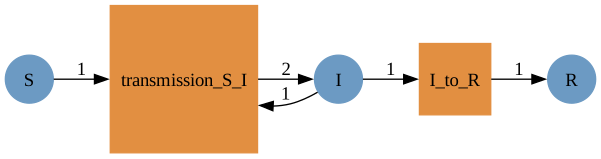
Transition names are unique and descriptive: a single-input transition is input_to_output
(I_to_R), and a multi-input transition is box_input1_input2 (transmission_S_I). That makes
parameter assignment unambiguous.
vectorfield_flat turns the net into an in-place ODE right-hand side f!(du, u, p, t) over
labelled state and parameter vectors.
We can use the Tsit5 solver from the SciML package OrdinaryDiffEqTsit5 to integrate the ODEs generated from the Petri net.
NB: Naming the state in the ODEFunction lets the solution be indexed and plotted by compartment.
function solve_net(pn, u0, p, tspan)
    f = ODEFunction(vectorfield_flat(pn); sys = SymbolCache(collect(keys(u0))))
    return solve(ODEProblem(f, u0, tspan, p), Tsit5())
end

function solution_figure(sol, names; title, ylabel = "Population")
    fig = Figure(size = (760, 420))
    ax = Axis(fig[1, 1]; xlabel = "Time (days)", ylabel, title)
    for name in names
        lines!(ax, sol.t, sol[name]; label = string(name), linewidth = 2)
    end
    Legend(fig[1, 2], ax; framevisible = false)
    return fig
end

N = 1000.0
u0 = LVector(S = N - 10.0, I = 10.0, R = 0.0)
p = LVector(transmission_S_I = 0.5 / N, I_to_R = 0.25)
tspan = (0.0, 120.0)

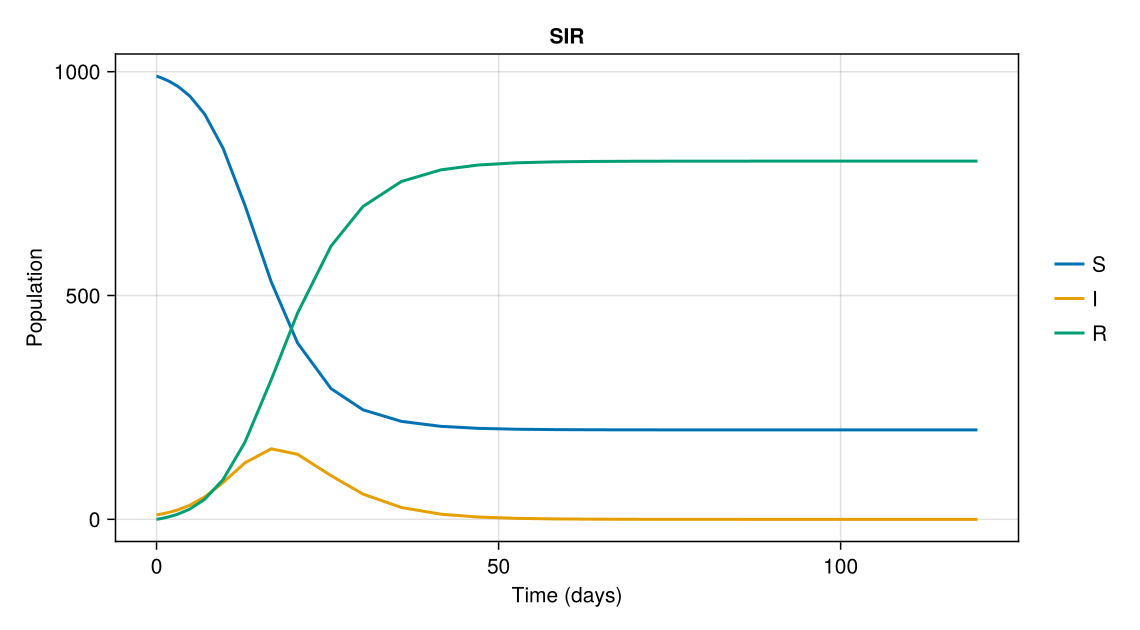
sol = solve_net(sir_pn, u0, p, tspan)
solution_figure(sol, keys(u0); title = "SIR")
Other Compartmental Models
SEIR Model
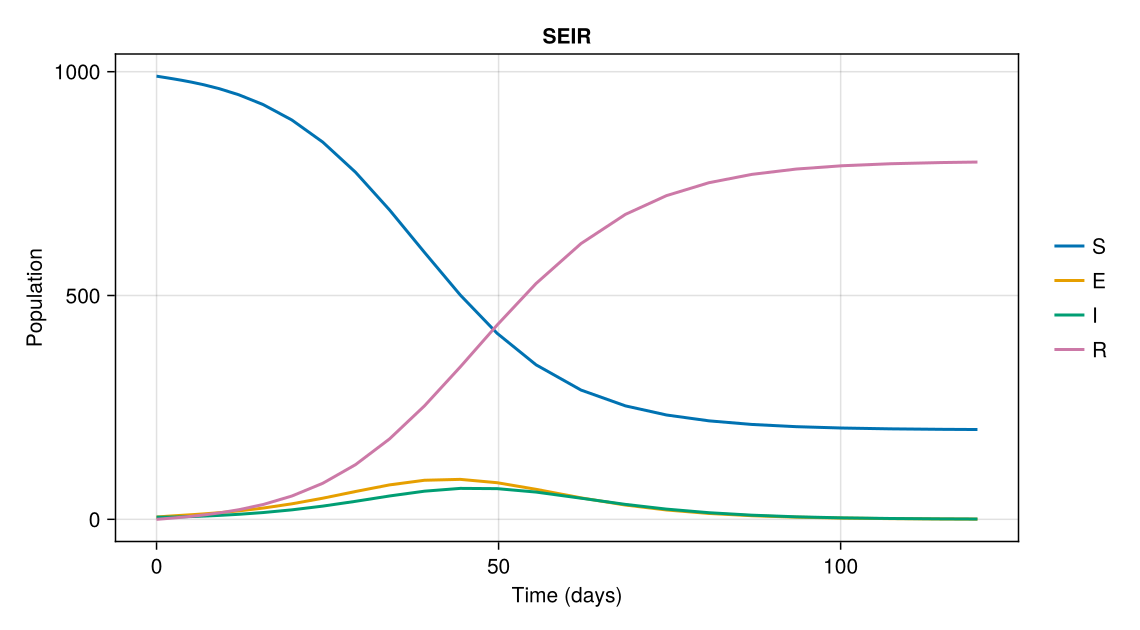
u0_seir = LVector(S = N - 10.0, E = 5.0, I = 5.0, R = 0.0)
p_seir = LVector(transmission_S_I = 0.5 / N, E_to_I = 0.2, I_to_R = 0.25)
sol_seir = solve_net(seir_pn, u0_seir, p_seir, tspan)
solution_figure(sol_seir, keys(u0_seir); title = "SEIR")
Multi-stage compartments
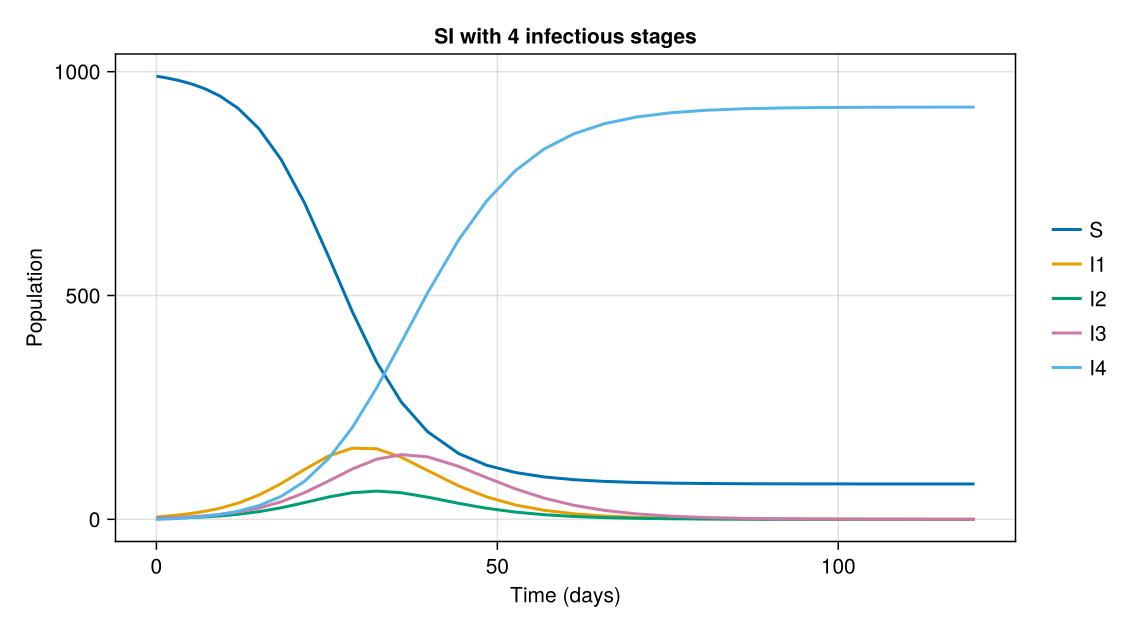
Splitting a compartment into sequential stages gives phase-type (for equal rates, Erlang) dwell times instead of exponential ones. Here the infectious period has four stages, each with its own transmission rate, which gives a time-since-infection infectiousness profile.
si_multi_pn = dom(create_model(typing, SI(number_I_stages = 4)))
(species = snames(si_multi_pn), transitions = tnames(si_multi_pn))
(species = [:I1, :I2, :I3, :I4, :S], transitions = [:I1_to_I2, :I2_to_I3, :I3_to_I4, :transmission_S_I1, :transmission_S_I2, :transmission_S_I3, :transmission_S_I4])
u0_si = LVector(S = N - 10.0, I1 = 5.0, I2 = 3.0, I3 = 2.0, I4 = 0.0)
p_si = LVector(
    transmission_S_I1 = 0.1 / N, transmission_S_I2 = 0.5 / N,
    transmission_S_I3 = 0.25 / N, transmission_S_I4 = 0.0,
    I1_to_I2 = 0.2, I2_to_I3 = 0.5, I3_to_I4 = 0.2,
)
sol_si = solve_net(si_multi_pn, u0_si, p_si, tspan)
solution_figure(sol_si, keys(u0_si); title = "SI with 4 infectious stages")
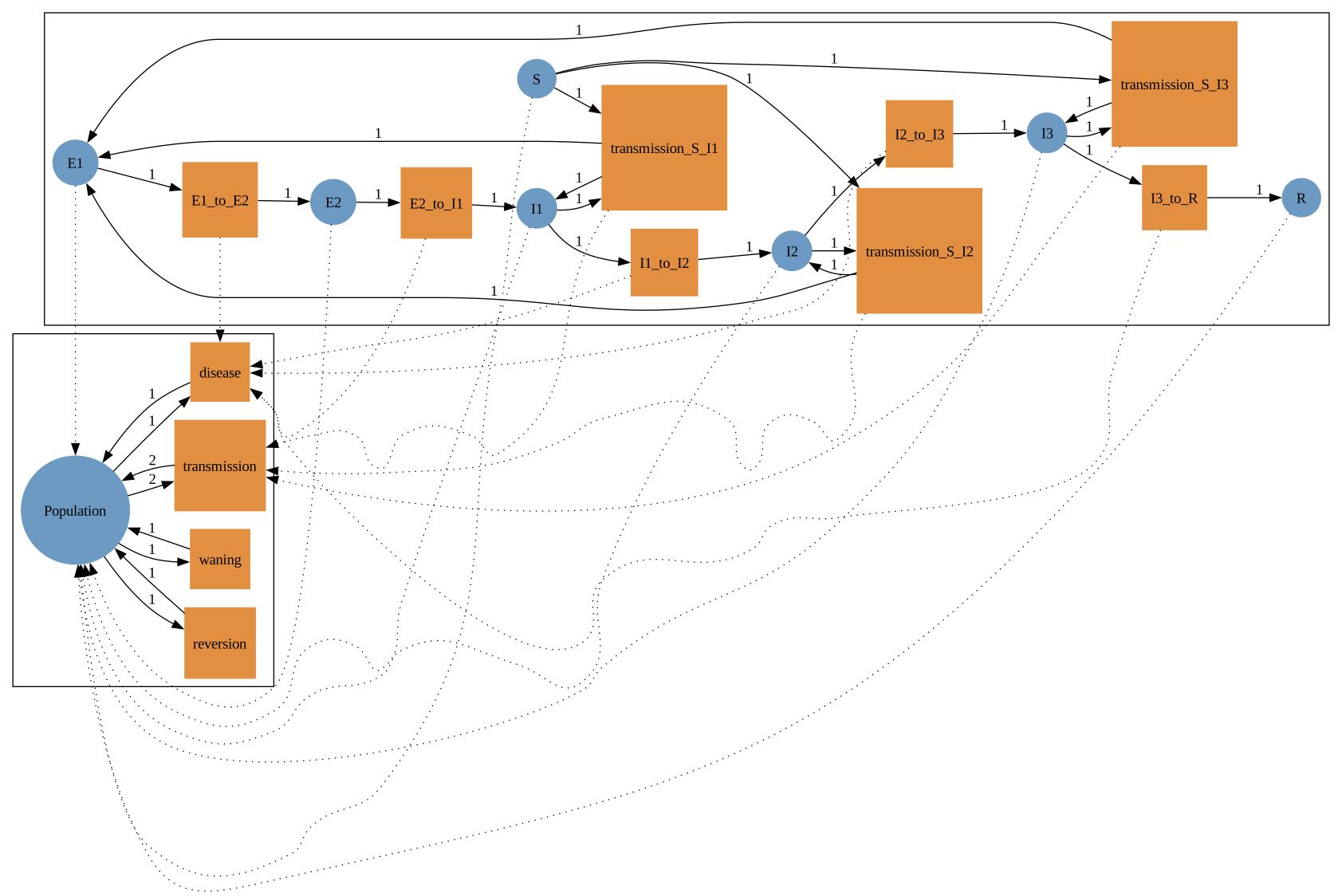
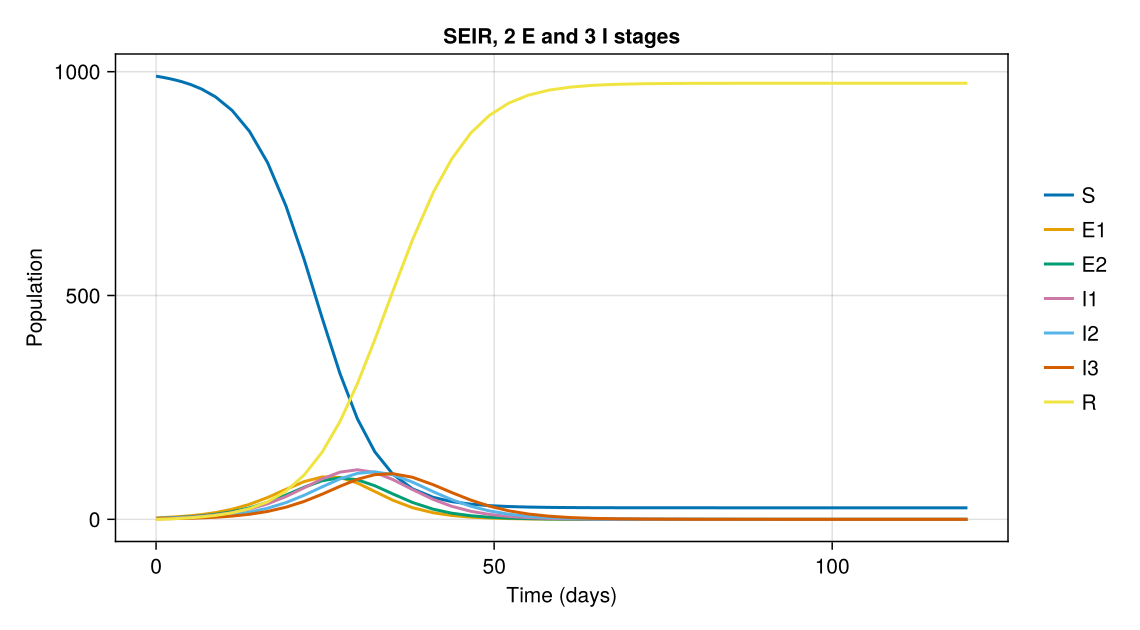
Stages combine freely: an SEIR with two exposed and three infectious stages has eight transitions, each with a unique name.
seir_multi_typed = create_model(typing, SEIR(number_E_stages = 2, number_I_stages = 3))
to_graphviz(seir_multi_typed)
u0_sm = LVector(S = N - 10.0, E1 = 3.0, E2 = 2.0, I1 = 2.0, I2 = 2.0, I3 = 1.0, R = 0.0)
p_sm = LVector(
    transmission_S_I1 = 0.5 / N, transmission_S_I2 = 0.5 / N, transmission_S_I3 = 0.5 / N,
    E1_to_E2 = 0.5, E2_to_I1 = 0.5, I1_to_I2 = 0.4, I2_to_I3 = 0.4, I3_to_R = 0.4,
)
sol_sm = solve_net(dom(seir_multi_typed), u0_sm, p_sm, tspan)
solution_figure(sol_sm, keys(u0_sm); title = "SEIR, 2 E and 3 I stages")
Observation delay chains
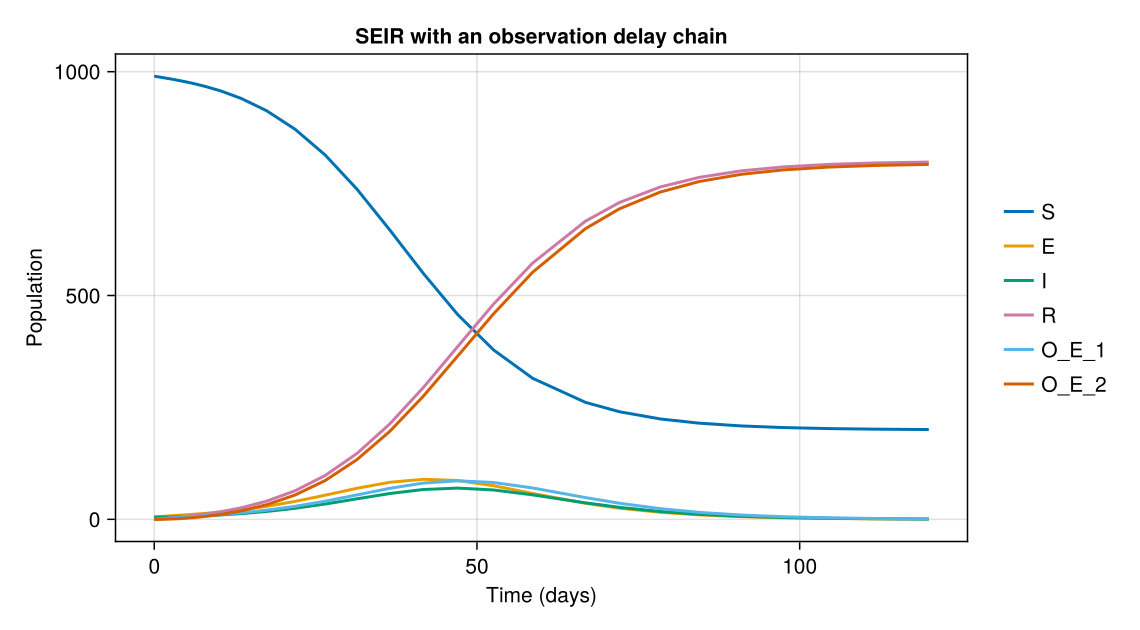
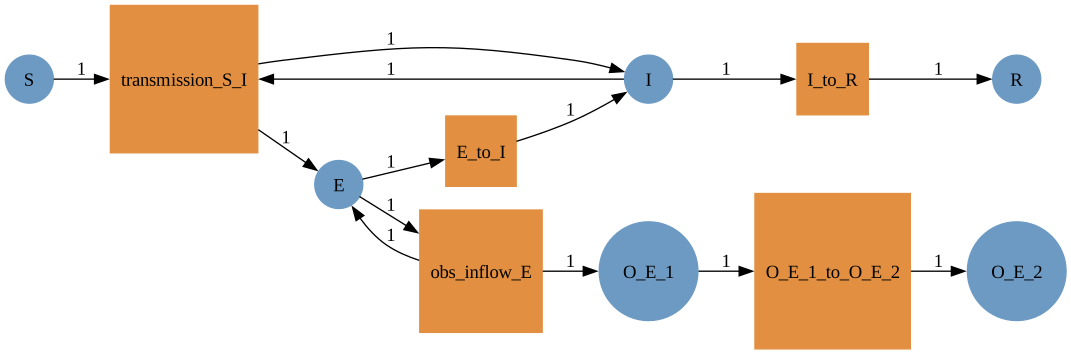
Surveillance sees a delayed version of the epidemic. attach_observation adds an observation
delay chain to a built net by pushout. There are two observation flavors:
AtCompartment(:X)samples a compartment: a catalytic transitionX → X + O_X_1fires at a rate times the occupancy ofXand leavesXunchanged. This is a prevalence-type signal such as test positivity.AtEvent(:transition)records a transition's flow instead. This is an incidence-type signal such as emergency-department arrivals.
The chain O_X_1 → O_X_2 → … is an Erlang delay; the last stage accumulates. Because the chain is
part of the net, attaching it to a stratified model gives each stratum its own chain.
seir_obs_pn = attach_observation(dom(create_model(typing, SEIR())), AtCompartment(:E); n_stages = 2)
to_graphviz(seir_obs_pn)
u0_obs = LVector(S = N - 10.0, E = 5.0, I = 5.0, R = 0.0, O_E_1 = 0.0, O_E_2 = 0.0)
p_obs = LVector(transmission_S_I = 0.5 / N, E_to_I = 0.2, I_to_R = 0.25, obs_inflow_E = 0.2, O_E_1_to_O_E_2 = 0.2)
sol_obs = solve_net(seir_obs_pn, u0_obs, p_obs, tspan)
solution_figure(sol_obs, keys(u0_obs); title = "SEIR with an observation delay chain")